Self-education is the only way to become a person that no school program can ever create. In over 13 years as a peer-reviewed scholar and teacher, I have worked closely with countless students and observed certain core principles at work among the best students.
自我教育是成为一个人的唯一途径这是任何学校课程都无法造就的。在超过13年的同行评审学者和教师生涯中,我与无数学生密切合作并观察到某些核心原则在起作用在最优秀的学生身上。
And while I'm not so self-confident as to call myself a self-taught genius, I've observed these same principles among both my mentors and extraordinary independent thinkers, all of whom are undoubtedly self -taught geniuses.
虽然我并没有那么自信以至于称自己为自学成才的天才,但我观察到这些相同的原则在我的导师们以及非凡的独立思考者身上都有体现,他们无疑都是自学成才的天才。
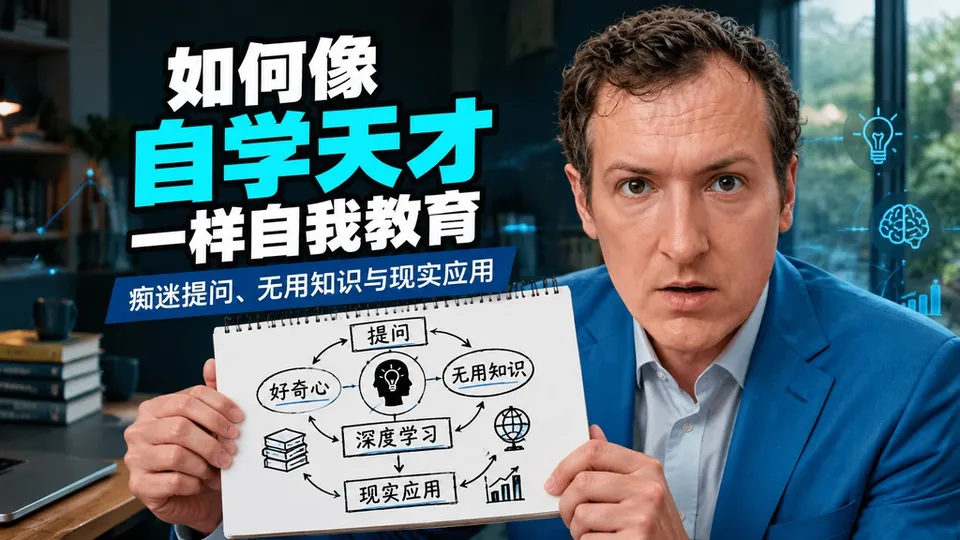
So in this video, I'll teach you how to implement the three most important of these principles. Starting with principle number one , find a question that you are obsessed with answering.
所以在这个视频中,我将教你如何实施其中最重要的三个原则。从第一条原则开始,找到一个你痴迷于回答的问题。
For me, this question began to form in high school. You see , at that time my parents had recently divorced. My family was poor at the time , so I was lucky to attend a private high school on a scholarship.
对我来说,这个问题在高中时就开始形成了。你看,那时我父母刚离婚不久。当时我家很穷,所以我有幸凭奖学金上了一所私立高中。
During my last year of school, an elective course in philosophy was offered, oddly enough. And in that class we read everyone from Aristotle to Nietzsche and many thinkers in between.
在我上学的最后一年,学校开设了一门哲学选修课,说来也怪。在那门课上,我们读了从亚里士多德到尼采的所有人,以及其间许多思想家的著作。
And something about that class lit a spark in me that I couldn't put out. Since then, I have constantly asked myself, “What makes something ethical?” What exactly is this thing we call value?"
而那门课在我心中点燃了火花我无法将其熄灭。从那以后,我不断问自己,“是什么让一件事合乎伦理?”我们称之为价值的东西到底是什么?
And these questions became the center of gravity around which undergraduate education would be organized. But, and this is important, these questions did not inherently limit me to one subject of research.
这些问题成了重心所在本科教育将围绕其组织起来。但是,这一点很重要,这些问题并没有从本质上限制我只研究一个学科。
For example, if I had simply decided to study philosophy, I would simply not come close to understanding these questions, let alone answering them in full. I realized that to understand value, of course I needed philosophy, but I also needed to neurobiology, psychology, anthropology, history, linguistics, and basically any field that might hold part of the answer.
例如,如果我只是决定学习哲学,我根本不会接近理解这些问题,更不用说完整地回答它们了。我意识到,要理解价值,当然我需要哲学,但我也需要神经生物学、心理学、人类学、历史学、语言学,以及基本上任何可能掌握部分答案的领域。
And so I ended up in courses I wasn't even registered for. I took piles of books from the university library and so on every week. And so, in effect , I was building a curriculum around a specific problem, not a field.
于是,我最终去上了那些我甚至没有注册的课程。我从大学图书馆搬来成堆的书如此每周不断。因此,实际上,我是在围绕一个具体问题构建课程体系,而不是一个领域。
And this is key. You see, people often tell you to study what you love or follow your passion, but let's be honest. Love can be fleeting, and passion can overheat like a flash in a frying pan, and therefore can be unstable.
而这是关键所在。你看,人们常常告诉你要学习你所热爱的东西或者追随你的热情,但老实说。爱可能转瞬即逝,而热情可能过热,就像煎锅里的闪光,因此可能不稳定。
After all, you can love physics documentaries without frustration required to actually learn physics, right? And so having a real question creates a different kind of motivation, namely motivation constant tension around the incompleteness of your understanding.
毕竟,你可以喜欢物理纪录片而无需真正学习物理所必需的挫败感,对吧?因此,拥有一个真正的问题会创造一种不同的动力,即持续紧张的动力围绕着你理解中的不完整性。
For example, you come back to this problem while taking a walk. Well, in the middle of a conversation or even in the middle of the night. Sound familiar? Well, there is actually good research for this.
例如,你在散步时又回到这个问题上。嗯,在谈话中间甚至在三更半夜。听起来很熟悉?其实,对此有很好的研究。
In a large meta-analytic called “The Hungry Mind,” psychologists Sophie von Stumm, Benedict Hell, and Thomas found that intelligence, as measured by IQ, is the strongest single success.
在一项名为《饥饿的头脑》的大型元分析中,心理学家索菲·冯·施图姆,本尼迪克特·赫尔和托马斯发现,智力,以智商来衡量,是单一最强的成功因素。
In other words, cognitive abilities are absolutely important. Of course. But intellectual curiosity and conscientious effort also mattered independently, and their combined predictive effect actually rivaled the influence of intelligence.
换句话说,认知能力绝对重要。当然。但求知欲和认真努力也独立发挥着作用,而且它们综合起来的预测效果实际上堪比智力的影响。
And so, of course, I'm not saying that curiosity simply ases the difference in IQ. Instead, it means that IQ is only one part of the equation for becoming a self-taught genius. And physicist Michael Faraday is a prime example of this.
所以,当然,我并不是说好奇心就能简单地解释智商上的差异。相反,这意味着智商只是等式的一部分对于成为一个自学成才的天才来说。物理学家迈克尔·法拉第就是一个典型的例子。
He had little formal education and was apprenticed to a bookbinder for 7 years. Books passing through the workshop introduced him to science, and he began attending lectures by chemist Humphry Davy.
他几乎没有接受过正规教育并当了一名书籍装订工的学徒为期7年。经过工坊的书籍将他引入了科学之门,他开始参加化学家汉弗莱·戴维的讲座。
Faraday created a complex set of notes, bound them together, and sent them to Davy . This eventually helped him to join the Royal Institution as a laboratory assistant. And it was this former bookbinder who discovered electromagnetic induction and changed our understanding of electricity and magnetism.
法拉第做了一套复杂的笔记,把它们装订在一起,然后寄给了戴维。这最终帮助了他加入皇家学会担任实验室助理。正是这位曾经的装订工发现了电磁感应,并改变了我们对电和磁的理解。
But here's the thing: Faraday didn't start by asking what degree he needed to study or what qualifications he needed to obtain. Instead, he followed the problem closely enough that it led him to institutions that initially had no obvious place for a person with his experience.
但事情是这样的:法拉第并不是从询问他需要攻读什么学位或需要获得什么资格开始的。相反,他足够密切地关注这个问题以至于它引导他进入了那些机构这些机构最初并没有明显的位置适合像他这样有经验的人。
But here's the thing: the question is only at the beginning of this process. This alone won't suddenly turn you into a self-taught genius will change the world. And that brings us to principle number two: embrace the joy of unnecessary knowledge.
但事情是这样的:问题只是这个过程的开始。仅凭这一点不会突然把你变成一个自学成才的天才,将会改变世界。这就引出了我们的第二条原则:拥抱无用知识的乐趣。
So, I've been taking Chinese (Mandarin) classes for the past few months and recently started thinking about what aspects of my practice are actually helping me remember characters, vocabulary, and grammar.
所以,我一直在上中文(普通话)课在过去几个月里最近开始思考我的练习中哪些方面实际上在帮助我记住汉字、词汇和语法。
And the common denominator was, was it brute force? Was it just rough discipline on my part? Was it even intentional viewing and all the other life hacks that learning influencers talk about ? Not quite.
而共同点在于,是靠死记硬背吗?这只是我这边粗略的纪律吗?这甚至是有意观看以及其他生活小窍门吗那些学习博主谈论的?不完全是。
In fact, it was just a game. You see, I like to watch movies in my free time, so I look for movies with subtitles or even movies in Chinese with Chinese and English subtitles. And when I watch them, I actively try to recognize and pronounce what appears on the screen .
事实上,这只是一场游戏。你看,我空闲时间喜欢看电影,所以我会找有字幕的电影甚至是中文电影有中英文字幕的。当我观看它们时,我会积极地尝试辨认和发音屏幕上出现的内容。
And when I spend time with my Chinese friends, I try to only use Chinese to converse. And it's challenging, but rewarding enough that I do it without one, putting it in the context of formal learning , and the other, making the activity feel like work.
当我和中国朋友相处时,我尽量只用中文交谈。这很有挑战性,但回报丰厚,以至于我没有它也能坚持,把它置于正式学习的背景下,而另一个,让这项活动感觉像工作。
And this seemingly impractical hobby helped me create one of the most important works of my life. While studying full- time in the natural sciences at Columbia University, I was writing a book on value theory, essentially the culmination of all the relentless self- study I had done while I was a student.
而这个看似不切实际的爱好帮助我创作出了我一生中最重要的作品之一。在哥伦比亚大学全日制攻读自然科学期间,我写了一本关于价值理论的书,这基本上是我所有不懈自学成果的总结,那些自学是我在学生时代完成的。
And you see, I was in abject poverty, barely able to afford rent, but I would often stay up late, sketching out just a few pages of a chapter or section here and there. You see, my original plan was to become a doctor, mainly because I felt it was my only path to financial stability.
你看,我当时一贫如洗,连房租都几乎付不起,但我常常熬夜,草草写下几页零零散散的章节或段落。你看,我原本的计划是成为一名医生,主要是因为我感觉这是我实现财务稳定的唯一途径。
And so I had no clear professional reason to write this book, nor even any guarantee that anyone would ever want to publish it. And that's basically the definition of futility, isn't it?
所以我写这本书并没有明确的职业理由,甚至没有任何保证会有人愿意出版它。这基本上就是徒劳无益的定义,不是吗?
But I just had this overwhelming feeling that I needed to write it. No other reason than this. And this project eventually became my first publication in one of the most prestigious scientific publishing houses in the world, even though I did n't even have a doctorate .
但我就是有一种强烈的感觉我需要把它写出来。除此之外,没有其他原因。而这个项目最终成为了我的第一篇发表作品发表在世界上最负盛名的科学出版机构之一,尽管我当时甚至还没有博士学位。
And so this is where I want to thoroughly intuition. You see, rationality does not require us to pretend that conscious thought is our only useful source of information. In their 2005 experiment on the speed of intuition, psychologists Annette Bolten and Thomas Gosch found that people can sometimes distinguish sets of words that have a hidden connection from sets that do not, even when they cannot yet determine how the words are related to each other.
所以这就是我想要彻底直观理解的地方。你看,理性并不要求我们假装有意识的思考是我们唯一有用的信息来源。在2005年关于直觉速度的实验中,心理学家安妮特·博尔滕和托马斯·戈施发现人们有时能够区分具有隐藏联系的词组与没有隐藏联系的词组,即使他们尚无法确定这些词之间是如何相互关联的。
In other words, the mind can often register a pattern before it can explain it . And similarly, you may subconsciously have some level of awareness of how the concepts you're learning are related, whether or not you can already put it into words .
换句话说,大脑往往能先识别出一种模式然后才能解释它。同样地,你可能在潜意识中已经有某种程度的觉察意识到你正在学习的概念之间是如何关联的,无论你是否已经能够用语言表达出来。
In their 1999 study, the self-concordance model, Cannon Sheldon and Andrew Elliott found that people put more effort into goals that align with their deeper interests and values, making those goals more likely to be achieved.
在他们1999年的研究中,自我一致性模型,坎农·谢尔顿和安德鲁·埃利奥特发现,人们会为目标付出更多努力当这些目标与更深层的兴趣和价值观一致时,从而使这些目标更有可能实现。
So, your intuition may not know where a particular field of knowledge will ultimately lead, but it can recognize which path resonates with your mind and which path you should continue to follow long enough to discover or even create its usefulness.
所以,你的直觉可能不知道某个特定知识领域最终会通向何方,但它能识别出哪条路径与你的思维产生共鸣以及哪条路径你应该继续坚持足够长的时间以发现甚至创造其价值。
And the great thinker Claude Shannon is a great example of such intellectual play and intuitive thinking. Shannon actually rode a unicycle through Bell Labs, juggling and constructing all sorts of bizarre devices.
伟大的思想家克劳德·香农就是这种智力游戏和直觉思维的绝佳例证。香农曾骑着独轮车穿过贝尔实验室,一边杂耍一边搭建各种奇特的装置。
His mechanical mouse for solving mazes and his work on chess automata, whose usefulness was not initially obvious, were later recognized as groundbreaking experiments in machine learning and artificial intelligence.
他那用于破解迷宫的发条老鼠以及他在象棋自动机方面的研究,其用途起初并不明显,后来却被认定为开创性的实验,在机器学习和人工智能领域。
And this same brilliant mind used George Boole's abstract algebra of logic to establish the mathematical foundation of digital switching circuits. When Shannon began developing information theory, he started with a practical engineering question: how can information be transmitted reliably over a noisy channel?
而正是这同一个卓越的头脑,运用乔治·布尔的抽象逻辑代数为数字开关电路奠定了数学基础。当香农开始发展信息论时,他从一个实际的工程问题入手:信息如何能够可靠地通过有噪声的信道传输?
But he refused to leave the matter at this practical, immediately useful level. He spent about a decade turning it into a highly mathematical theory whose ultimate application, which applies to so much of modern technology, simply could not yet be foreseen.
但他拒绝将问题停留在这种实用的、立即可用的层面。他花了大约十年时间把它变成了一门高度数学化的理论其最终的应用,适用于如此多的现代技术,在当时根本无法预见。
And so, like Shannon, don't be afraid to engage in such playfulness, patterns, to construct things, to follow connections whose full value is not always immediately apparent. Because eventually, their application to your life will become clearer and clearer.
因此,像香农一样,不要害怕参与这种玩乐,模式,去构建事物,去追寻那些其全部价值并不总是立即显现的联系。因为最终,它们在你生活中的应用会变得越来越清晰。
Which brings us to principle number three. Find a practical way. You see, there is actually a hidden danger in everything we have discussed so far, and it is worth clearly understanding it.
这就引出了第三条原则。找到一种切实可行的方法。你看,实际上存在一个隐患在我们目前讨论的所有内容中,而且它值得被清楚地理解。
You see, during my time in college, I accumulated a huge student debt, which fortunately I have already paid off. However, it was stifling at the time , and it's the reason that eventually led me to start running several businesses, and it's also the main reason why I never got a PhD, even though I was reviewed at the academic publisher Springer without one.
你看,在我上大学期间,我积累了一大笔学生债务,幸运的是我已经还清了。然而,当时这让人感到窒息,而这就是原因最终促使我创办了好几家企业,这也是我一直没有攻读博士学位的主要原因,尽管我在没有博士学位的情况下得到了学术出版社施普林格的审阅。
You see, I originally came into the business world for a very unromantic reason. I needed to get out of debt. And as a result, I had to admit uncomfortable to myself. My studies sometimes became a form of escape from reality.
你看,我最初进入商界是出于一个非常不浪漫的原因。我需要摆脱债务。结果,我不得不对自己承认一些令人不安的事实。我的学习有时成了一种逃避现实的方式。
You see, if I had stayed inside philosophy, science, and all my beautiful, useless knowledge, I could have avoided the cold reality that rent had to be paid, and that knowledge alone did not guarantee that anyone would pay me.
你看,如果我当初一直留在哲学、科学,以及所有我那些美好却无用的知识里,我本可以避开房租必须支付这一冷酷现实,也可以避开仅仅拥有知识并不能保证有人会付钱给我的这一事实。
But my response was not to abandon the theory. Instead, I connected this theory to problems that had real, tangible consequences. You see, running a business forced me to master people-oriented skills that I hadn't developed by relentlessly reading and writing in that library, skills like communication, sales, negotiation, management, and truly understanding another person's needs.
但我的回应并不是放弃这个理论。相反,我把这个理论与那些具有真实的、切实后果的问题联系了起来。你看,经营一家企业迫使我去掌握以人为本的技能,而这些技能我并没有通过在那间图书馆里不停地阅读和写作而培养出来,比如沟通、销售、谈判、管理,以及真正理解另一个人的需求。
And gradually I started to see connections that other people in these business contexts missed. In fact, the philosophy, cognitive science, and all these other abstract topics that I studied became practical in the test prep business that I eventually created in Flushing, New York.
渐渐地,我开始看到一些联系这些商业环境中的其他人错过了。事实上,哲学、认知科学,以及所有这些其他抽象话题我所研究的在备考业务中变得实用了我最终在法拉盛创建的,纽约。
And so this knowledge , although it seemed unnecessary at first, was not unnecessary in the end. I just haven't yet encountered an environment in which this unusual combination would become economically valuable.
所以这些知识,尽管起初看起来毫无必要,最终却并非毫无必要。我只是尚未遇到一个环境,在其中这种不同寻常的组合会变得具有经济价值。
And helps explain this. In a 2013 study called “Atypical Combinations and Scientific Impact,” Brian Uzzi and his colleagues analyzed 17.9 million scientific publications from 1950 to 2000.
并且有助于解释这一点。在2013年一项名为“非典型组合与科学影响力”的研究中,布莱恩·乌齐和他的同事分析了1790万篇科学出版物从1950年到2000年。
They found that the most cited research typically combined a strong foundation of traditional knowledge with fewer between disciplines that were rarely brought together. So the practical lesson here is not just that you should just collect random knowledge from many subjects as possible.
他们发现,被引用最多的研究通常结合了坚实的传统知识基础与较少的跨学科且很少被结合在一起的领域。所以这里的实际教训不仅仅是你应该只是收集随机的知识从尽可能多的学科中。
First, develop true competence in one area. around your core question or set of questions. But then use everything else you've learned to present an idea or perspective that most people in the field typically overlook.
首先,在一个领域发展真正的能力。围绕你的核心问题或一系列问题。但然后运用你学到的其他一切来提出一个想法或视角,而该领域中大多数人通常会忽略。
Because, for example, your advantage may not be that you know more about economics than any economist. Instead, it might be that you can bring psychology , say, into a financial context, or history into product design, or linguistics into artificial intelligence, and so on.
因为,例如,你的优势可能不在于你比任何经济学家都更懂经济学。相反,可能是你可以将心理学,比如说,带入金融领域,或者将历史带入产品设计,或者将语言学带入人工智能,等等。
In fact, your ultimate niche may exist at the intersection of fields that no department ever intended to name. And one of my favorite lesser- known examples of this is the thinker James Kroll.
事实上,你最终的细分领域可能存在于各领域的交叉点,那是任何院系都未曾打算命名的。而我最喜欢的一个鲜为人知的例子就是思想家詹姆斯·克罗尔。
Born into a poor Scottish farming family, Croll left school at 13 and worked an almost haphazard series of jobs: miller, tea merchant, hotelier, insurance agent, and eventually cleaner at the Anderson Institute in Glasgow.
出生于苏格兰一个贫穷的农民家庭,克罗尔13岁便离开了学校并做过一系列几乎杂乱无章的工作:磨坊主、茶商、旅馆老板、保险agent,最终成为清洁工在格拉斯哥的安德森学院。
And, you see, this position gave him access to the library. And thanks to this, he independently studied physics and astronomy and developed a theory linking changes in the Earth's orbit to ice ages.
你看,这个职位让他得以进入图书馆。正因如此,他独立研究了物理学和天文学并发展出一套理论将地球轨道的变化与冰河时期联系起来。
Eventually, his work appeared in the Philosophical Journal in 1864 and helped him secure a position at the Geological Survey of Scotland. So from the outside, Kroll's path looks incoherent until it finally worked.
最终,他的成果发表于1864年的《哲学杂志》这帮助他获得了职位在苏格兰地质调查局。所以从表面上看,克罗尔的路径看似毫无条理,直到最终奏效。
The practical opportunity did not simply exist for him in advance, telling him what to study. Instead, his knowledge, access to work, and a real scientific problem collided, and suddenly the path became visible.
实际的机会并非仅仅预先为他而存在,告诉他该学习什么。相反,他的知识、工作机会,以及一个真实的科学问题相互碰撞,突然间,道路变得清晰可见。
So, I hope you see that I am not suggesting here that the self-taught rejects teachers, institutions, or experience. Ultimately, Faraday needed Davy and the Institution. Kroll a library and the Geological Survey.
所以,我希望你们明白,我在这里并不是在暗示自学成才者拒绝老师、机构或经验。最终,法拉第需要戴维和研究所。克罗尔需要图书馆和地质调查局。
I needed professors, friends, mentors, publishers, clients, and students. Instead, self-education simply means that no institution has the final authority over the limits of your curiosity.
我需要教授,朋友、导师、出版商,客户和学生。相反,自我教育只是意味着没有任何机构拥有最终权威来限制你好奇心的边界。
In other words, you accept help from everywhere, but ultimately take responsibility for putting together the curriculum. If you want to continue to improve your critical thinking skills so you can have a huge impact not only on your own life, but on the lives of countless others, check out this next video.
换句话说,你接受来自各处的帮助,但最终要承担责任来组合自己的课程。如果你想继续提高你的批判性思维能力从而不仅对你自己的生活产生巨大影响,还能影响无数其他人的生命,请查看下一个视频。