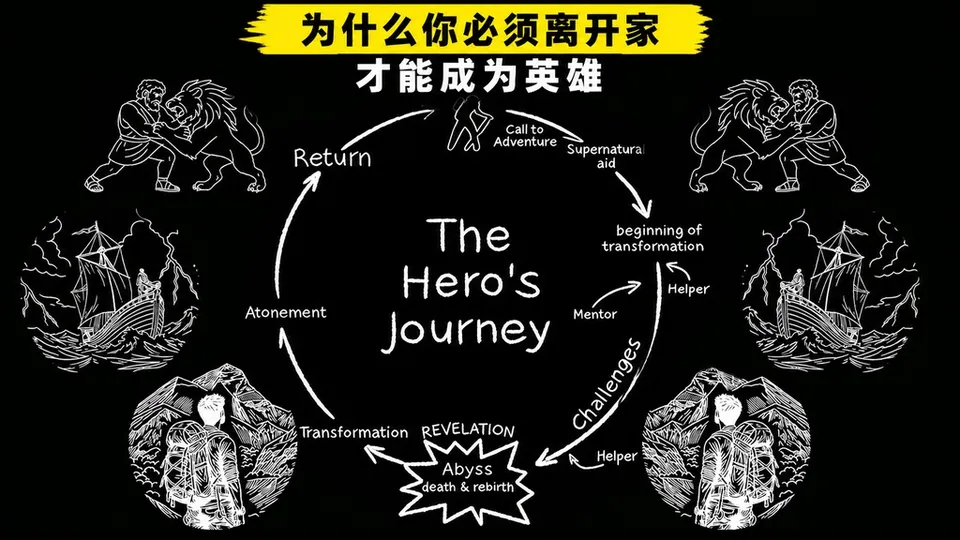
Before the hero can become the hero, he leaves home. Long before people spoke about personal growth, identity, self-development, or finding your purpose, human beings were already telling stories that began with the same strange movement.
在英雄成为英雄之前,他离开了家。早在人们谈论个人成长、身份认同、自我发展或寻找人生目标之前,人类就已经在讲述故事,而这些故事都始于同一个奇异的举动。
Someone was living inside a familiar world, surrounded by people they knew, following patterns that had existed for years, and then something called them away from it. The hero leaves the village and walks toward a place he has never seen.
有人生活在一个熟悉的世界里,身边都是他们认识的人,遵循着已存在多年的模式,然后有某种东西召唤他们离开这一切。英雄离开村庄走向一个他从未见过的地方。
The seeker disappears into the desert. A prince crosses the gates of the palace that protected him. A young man boards a ship and watches the shore of his homeland disappear behind him.
寻道者消失在沙漠中。一位王子穿过曾经保护他的宫殿大门。一个年轻人登上一艘船望着故乡的海岸在身后消失。
Again and again, the important life begins somewhere beyond the border of the known world. Ancient storytellers understood that something happens when a person crosses that border.
一次又一次,重要的生活总是在某处开始在已知世界的边界之外。古代的说书人明白,当一个人跨越那道边界时,会发生一些事情。
A life that had already been arranged begins to open. The person who knew where he belonged suddenly has to discover where he belongs. The person whose future seemed predictable enters a world where almost nothing is certain.
一段早已被安排好的生活开始展开。那个曾知道自己归属的人突然不得不去发现自己究竟归属何处。那个未来看似可预测的人踏入了一个世界在那里,几乎没有什么事是确定的。
And somewhere inside that uncertainty, another person begins to emerge. One of the oldest and clearest examples appears near the beginning of Genesis. Abram is living among his people when he receives a command that changes the direction of his entire life.
而在那种不确定之中,另一个人开始浮现。最古老、最清晰的例子之一出现在《创世记》的开头附近。亚伯兰与他的族人同住时,接到了一道命令,这命令改变了他整个一生的方向。
God does not begin by giving him a detailed map of the future. He is not shown every difficulty waiting ead or told exactly how everything will work out. The command begins with a single demand, leave.
上帝并没有一开始就给他一张详尽的未来地图。他没有被告知前方等待的每一个困难,也没有被告知一切将如何成就。命令始于一个单一的要求:离开。
Genesis 12:1-4. Now the Lord had said unto Abram, "Get thee out of thy country, and from thy kindred, and from thy father's house, unto a land that I will show thee. And I will make of thee a great nation, and I will bless thee, and make thy name great, and thou shalt be a blessing.
创世记 12:1-4。耶和华曾对亚伯兰说:“你要离开本地,本族,父家,往我所要指示你的地去。我必叫你成为大国,我必赐福给你,叫你的名为大,你也要叫别人得福。
And I will bless them that bless thee, and curse him that curseth thee. And in thee shall all families of the earth be blessed. So, Abram departed, as the Lord had spoken unto him, and Lot went with him.
为你祝福的,我必赐福与他,那咒诅你的,我必咒诅他。地上的万族都要因你得福。于是,亚伯兰就去了,正如耶和华对他所说的,罗得也和他同去。
And Abram was 75 years old when he departed out of Haran. There is something powerful in the order of those words. First comes the departure. Leave your country. Leave your kindred.
亚伯兰离开哈兰的时候,年七十五岁。这句话的顺序里有某种强大的东西。首先是离开。离开你的国家。离开你的亲族。
Leave your father's house. Go toward a land that has not even been revealed to you yet. Only then comes the promise of what his life might become. The promise comes after the departure.
离开你父亲的家。前往一片尚未向你显露的土地。唯有如此,他的生命才可能有未来的应许。应许在离别之后到来。
Abram is told that his life can expand beyond anything he currently knows, but that future exists somewhere outside the boundaries of the world he has already built around himself.
亚伯兰被告知,他的生命可以扩展到远超他目前所知的一切,但那个未来存在于某处,在他已经为自己筑起的世界边界之外。
He has to move before he can see it. He has to step away from the place where his identity has already been formed, and enter a place where his identity is still unfinished. And perhaps that is one reason this story has remained so powerful for thousands of years.
他必须先迈出脚步,才能看见它。他必须离开那个他的身份已经定型的地方,进入一个他的身份仍未完成的地方。也许这就是这个故事数千年来如此震撼人心的原因之一。
Even outside its religious meaning, the image is immediately understandable. There are moments in life when the next version of you cannot be reached by repeating the life you already know.
即使抛开其宗教含义,这个意象也一目了然。人生中总有这样的时刻,下一个版本的你无法通过重复已知的生活来抵达。
You can keep waking up in the same place, having the same conversations, moving through the same routines, and receiving the same reactions from the same people, and years can pass without anything forcing you to question the person you have become.
你可以不断在同一个地方醒来,进行同样的对话,重复同样的日常,并从同样的人那里得到同样的反应,多年过去,没有任何事情迫使你质疑自己变成了什么样的人。
Familiarity gives life stability, and stability can quietly become a boundary. Abram is called beyond that boundary without knowing exactly what waits for him there. The uncertainty is part of the story.
熟悉感赋予生活稳定,而稳定可能悄然成为一道边界。亚伯兰被召唤越过那个边界却不知道确切地在那里等待他的是什么。不确定性是故事的一部分。
If the entire future had already been visible, leaving would have required far less faith. This pattern appears so often in ancient stories that the mythologist Joseph Campbell eventually made it central to his description of what he called the hero's journey.
如果整个未来早已可见,离开所需的信心就会少得多。这种模式在古代故事中频繁出现以至于神话学家约瑟夫·坎贝尔最终将其作为他所称的“英雄之旅”描述的核心。
Campbell studied myths from very different cultures and noticed that many of them seem to move through similar stages. The hero begins in an ordinary world. Something interrupts that world and calls him beyond it.
坎贝尔研究了来自截然不同文化的神话并注意到其中许多似乎经历了相似的阶段。英雄始于一个平凡的世界。某些事物打断了那个世界,并召唤他走向世界之外。
He crosses a threshold into unfamiliar territory where he encounters experiences that his previous life could never have prepared him for completely. Campbell called this movement the departure and it matters because the adventure cannot truly begin while the hero remains protected by everything familiar.
他跨过一道门槛,进入陌生的领域在那里,他遭遇了种种经历是他以往的生活永远无法让他完全做好准备应对的。坎贝尔将这一行动称为“启程”这很重要,因为冒险无法真正开始当英雄仍被一切熟悉的事物所庇护时。
The story needs a boundary and the hero needs to cross it. On one side is the life he understands. On the other side is the world that will test him. Somewhere between those two worlds, the person he used to be begins losing his certainty.
故事需要一个边界,而英雄需要跨越它。一边是他所理解的生活。另一边是将要考验他的世界。在这两个世界之间的某个地方,曾经的他开始失去自己的笃定。
Think about what home means in these stories. Home is rarely just a building. It is an entire system of familiarity. At home, people know your history. They know what you were like years ago.
想想在这些故事中家意味着什么。家很少仅仅是一座建筑。这是一个完整的熟悉体系。在家里,人们了解你的过往。他们知道你多年前是什么样子。
They remember the mistakes you made and the dreams you abandoned. There are expectations attached to your name. There are habits that return almost automatically because you have repeated them in that environment for so long.
他们记得你犯过的错还有你放弃的梦想。你的名字上附着着种种期望。有些习惯几乎会自动回来因为你已在那样的环境中重复了它们太久太久。
You know where you fit. Even rebellion can become predictable because everyone already knows how you rebel. This gives home an enormous psychological power. It continuously tells you who you have been.
你知道自己适合什么位置。即使是叛逆也可以变得可预测,因为每个人都已经知道你会如何叛逆。这赋予了“家”巨大的心理力量。它不断告诉你,你一直是什么样的人。
When you stay inside that world, the past is always close enough to speak. Sometimes it speaks through other people. Sometimes it speaks through your surroundings. Sometimes you simply feel it when you walk into an old room and notice how easily an older version of yourself returns.
当你停留在那个世界里时,过去总是近得足以开口说话。有时它通过别人说话。有时,它通过你周围的环境开口说话。有时,当你走进一个老旧的房间,你会简单地感觉到它并注意到过去的自己多么轻易地回归。
That is why leaving carries such symbolic weight. Once you cross into unfamiliar territory, many of those signals disappear. The new place has no memory of you. The street does not know what happened to you when you were 18.
这就是为什么离开承载着如此象征性的分量。一旦你踏入陌生的地域,许多这些信号便消失了。这个新地方对你没有任何记忆。这条街不知道你18岁时发生了什么。
The stranger standing in front of you does not know whether you were confident or insecure back home. Nobody automatically understands the role you normally play. The world becomes strangely silent about who you are supposed to be.
站在你面前的陌生人并不知道你在家乡时是自信还是缺乏安全感。没有人会自动理解你通常扮演的角色。这个世界对你该成为什么样的人变得异常沉默。
At first, that silence can feel uncomfortable because you have lost the familiar mirrors that reflected your identity back to you. Yet, the same silence creates space. You have to decide how you will speak, how you will behave, what you will tolerate, what kind of life you will build.
起初,那种沉默会让人感到不适因为你已经失去了那些熟悉的镜子它们曾将你的身份映照给你看。然而,同样的沉默也创造了空间。你必须决定自己将如何说话,如何行事,容忍什么,建设怎样的生活。
You begin discovering which parts of you were deeply yours and which parts depended heavily on the environment around you. Leaving makes identity less automatic. Another ancient story carries a similar image.
你开始发现哪些部分真正属于你自己哪些部分严重依赖于你周围的环境。离开让身份认同不再那么自然而然。另一个古老的故事也带有相似的意象。
Siddhartha Gautama, before becoming the Buddha, is traditionally described as growing up inside a protected palace life. His father wanted to shield him from the harsher realities of existence.
悉达多·乔达摩,在成为佛陀之前,传统上被描述为在受保护的宫廷生活中长大。他的父亲想保护他免受生存中更严酷的现实。
Comfort surrounded him and the world beyond the palace was kept at a distance. But eventually, Siddhartha sees what that protected world had hidden from The walls that made his life comfortable had also limited what he could understand about life.
舒适环绕着他而宫廷之外的世界则被隔绝在远处。但最终,悉达多看到了那个受保护的世界所隐藏的东西那些让他生活舒适的墙也限制了他对生活所能理解的程度。
His spiritual journey begins when he leaves the palace behind. He walks away from the identity prepared for him and enters a life whose outcome he cannot predict. The important part for our purpose is the movement itself.
他的精神之旅开始了当他将宫殿抛在身后。他离开了为他准备好的身份进入了一种他无法预知结局的生活。对我们而言,重要的部分在于这个行为本身。
The palace represented a complete world with an already established answer to who Siddhartha was supposed to become. His departure created the possibility of asking a different question.
宫殿代表了一个完整的世界其中已经确立好了悉达多注定要成为谁的答案。他的离开创造了可能性去提出一个不同的问题。
This is what ancient stories understood about becoming. There are questions you cannot seriously ask while every part of your environment keeps giving you the old answer. Who could you become somewhere else?
这就是古老故事对成长的理解。有些问题你无法认真提出当你周围的一切不断给你同样的旧答案。在别处,你能成为谁?
What would you believe if you were surrounded by different beliefs? What ambitions might appear if nobody around you had already decided what was realistic for someone like you? How much of your personality belongs to you and how much of it was shaped by a role you learned to perform because that role worked inside the world where you grew up?
如果你被不同的信仰所包围你会相信什么?如果你身边没有人已经认定像你这样的人什么才是现实的,那么你会萌生怎样的抱负?你的性格有多少属于你自己,又有多少是被你学会扮演的角色所塑造的,因为那个角色在你成长的世界里行之有效?
You cannot answer those questions completely through thought alone. At some point, the hero has to walk. He has to place enough distance between himself and the familiar world to discover what remains when its influence grows quieter.
你无法仅凭思考完全回答那些问题。到了某个时刻,主角必须迈步前行。他必须在自己与熟悉的世界之间拉开足够的距离,才能发现当它的影响逐渐减弱时,还剩下什么。
There is also something unsettling about the fact that Abram is not told precisely where he is going. God tells him, "unto a land that I will show thee." The destination comes later.
还有一个令人不安的事实那就是亚伯兰并没有被告知他具体要去哪里。上帝告诉他:“往我所要指示你的地去。”目的地是后来才显明的。
That detail matters because people often imagine that they should leave only once they understand exactly who they will become somewhere else. They want certainty before movement. Ancient stories tend to reverse that order.
这个细节很重要,因为人们常常以为只有当他们确切明白了自己在别处会成为什么样的人之后,才应该离开。他们希望在行动之前就获得确定性。古老的故事往往颠倒这一顺序。
The road reveals things that could not have been understood from the starting point. Abram cannot experience the land while remaining in Haran and thinking about it. Siddhartha cannot discover what exists beyond the palace while continuing to live behind its walls.
道路会揭示那些从起点无法理解的事物,从起点无法理解的事物。亚伯兰若留在哈兰,就无法体验那地并思考它。悉达多若继续生活在宫墙之内就无法发现宫墙之外存在着什么。
The hero cannot know what the journey will make of him before the journey has begun. Part of leaving is accepting that you are walking toward a future that your present self cannot completely imagine.
英雄在旅程开始之前无法知道旅程会将他塑造成什么。离别的一部分是接受你正走向一个未来你现在的自己无法完全想象。
And this may be why the first step of so many great stories feel surprisingly ordinary. The hero has not defeated anything yet. No monster lies dead at his feet. He has not become wise.
而这也许就是为什么许多伟大故事的第一步感觉出奇地平凡。主角还没有战胜任何东西。他脚下没有死去的怪物。他没有变得睿智。
He has not earned glory. At the beginning, he is simply someone standing at the edge of the familiar world and deciding whether to remain there. Everything behind him is understandable.
他没有赢得荣耀。起初,他只是一个站在熟悉世界边缘的人并决定是否留在那里。他身后的一切都是可以理解的。
Everything ead is uncertain. The old life still offers comfort, recognition, routine, and a clear identity. The road offers none of those guarantees, yet the road contain contains one possibility that home cannot give him any more.
前方的一切都是未知的。旧生活仍能提供慰藉,认可、日常规律和清晰的身份。而这条路无法给予任何这些保证,但这条路包含着一种可能性,是家再也无法给予他的。
The chance to encounter a version of himself that has never been required to exist. The hero's journey begins long before the battle. It begins before the great achievement and before anyone sees the hero as heroic.
遇见一个从未被要求存在的自己的版本的机会。英雄之旅早在战斗之前就已开始。它始于伟大成就之前,也始于任何人将英雄视为英雄之前。
It begins at the moment when a person realizes that the life which has formed him may no longer be large enough for the person he hopes to become. He looks toward the unknown without knowing exactly what he will find there.
它始于一个人意识到的那一刻:那个塑造了他的生活可能不再足够广阔,无法容纳他希望成为的那个人。他望向未知,并不确切知道自己会在那里找到什么。
And then he takes the first step away from everything that already knows his name. That step seems small compared with everything that comes later, but without it, there is no story.
然后他迈出第一步,离开一切早已熟知他名字的事物。那一步看似微小与后来发生的一切相比,但若没有它,便没有故事。
Abram must leave Haran. Siddhartha must cross the palace gates. The hero must pass beyond the boundary of the ordinary world. Before there can be transformation, there must first be departure.
亚伯兰必须离开哈兰。悉达多必须穿过宫门。英雄必须越过凡俗世界的边界。在蜕变发生之前,必先有离去。
You discover who you are when the familiar disappears. Leaving home begins the journey, but departure alone does not create the hero. Something has to happen after the person crosses the boundary of the familiar Ancient stories understood this clearly.
当熟悉的一切消失,你才会发现自己是谁。离开家,旅程就此开始,但仅凭离去,并不能造就英雄。人跨越之后必定会发生些什么……的边界那些熟悉的古老故事对此了然于心。
The hero leaves, and almost immediately the landscape changes. Civilization disappears behind him. The road becomes harder. The people who once surrounded him are gone. He enters the mountain, the desert, the dark forest, or some other place where a normal rules of life no longer seem to apply.
英雄离去,几乎就在同时,景色变了。文明在他身后消失。道路变得更加艰难。曾经围绕在他身边的人都不在了。他进入山中,沙漠、黑暗森林,或其他某个地方在那里,正常的生活规则似乎不再适用。
This is the wilderness, and it appears so often in ancient stories that it is difficult to treat it as coincidence. The wilderness is where the person loses access to the life that previously supported him.
这就是荒野,它在古老的故事中如此频繁地出现,以至于很难将其视为巧合。荒野是人失去生活依靠的地方,那曾支撑他的生活。
There is nobody nearby who already knows how to solve his problems. His name carries less meaning. The routines that once filled his days are gone. He has fewer places to hide from himself.
附近没有人已经知道如何解决他的问题。他的名字意义更少了。曾经充斥他日常的例行公事已不复存在。他逃避自己的地方更少了。
And somewhere inside that emptiness, qualities begin to appear that might have remained invisible for the rest of his life. The person who entered the wilderness eventually discovers that the landscape has been working on him the entire time.
而在那片空虚之中的某个地方,一些特质开始显现,这些特质或许在他余生中本会一直隐而不见。走进荒野的人最终会发现那片风景一直在塑造着他。
Few biblical stories show this more clearly than the story of Moses. Before Moses becomes the man who confronts Pharaoh and leads an entire people out of Egypt, he runs away from Egypt himself.
很少有圣经故事比摩西的故事更能清楚地说明这一点。在摩西成为那个直面法老的人之前并带领整个民族走出埃及之前他自己先从埃及逃走了。
His early life contains an unusual contradiction. He is born among the Hebrews, yet he grows up inside Pharaoh's household. He lives close to power while belonging to a people living under that power.
他早年的人生包含着一个不寻常的矛盾。他出生在希伯来人中间,却在法老的家中长大。他生活在权力近旁同时属于生活在那种权力之下的一个民族。
Then his life suddenly breaks apart. After killing an Egyptian who was beating a Hebrew, Moses learns that Pharaoh wants him dead. The future that seemed available to him disappears almost immediately.
随后他的生活突然破碎。在杀死一个殴打希伯来人的埃及人之后,摩西得知法老想要他死。他本可拥有的未来几乎立刻就消失了。
Exodus tells us that Moses fled from Pharaoh and settled in the land of Midian. The man who had grown up around the royal court is now far away from Egypt living among strangers and tending sheep.
《出埃及记》告诉我们,摩西逃离了法老并在米甸地定居下来。这个在王室宫廷中长大的人如今已远离埃及,生活在陌生人中间,以牧羊为生。
His life becomes smaller and hidden from the world he came from. Years pass this way. The great leader of Exodus spends a large part of his life doing something almost nobody would consider heroic.
他的生活变得越来越狭小并对他来自的世界隐藏起来。岁月就这样流逝。《出埃及记》的伟大领袖度过了他生命中的大部分时光做着几乎没有人会认为是英雄之举的事情。
He walks through empty country behind the flock. And it is there, far away from Pharaoh's court, that his life changes. Exodus 3:1-6 Now Moses kept the flock of Jethro, his father-in-law, the priest of Midian.
他走在羊群后面,穿过空旷的乡野。就在那里,远离法老的宫廷,他的人生发生了改变。出埃及记 3:1-6 摩西牧养他岳父米甸祭司叶忒罗的羊群,他岳父,米甸的祭司。
And he led the flock to the backside of the desert and came to the mountain of God, even to Horeb. And the angel of the Lord appeared unto him in a flame of fire out of the midst of a bush.
他领着羊群往旷野深处去到了神的山就是何烈山。耶和华的使者向他显现在火焰中从荆棘里。
And he looked, and behold, the bush burned with fire, and the bush was not consumed. And Moses said, "I will now turn aside and see this great sight, why the bush is not burnt." And when the Lord saw that he turned aside to see, God called unto him out of the midst of the bush and said, "Moses, Moses."
他观看见那荆棘被火烧着荆棘却没有烧毁。摩西说:“我要过去看这大异象,这荆棘为何没有烧坏呢?”耶和华见他过去要看,神就从荆棘里呼叫他说:“摩西,摩西。”
And he said, "Here am I." And he said, "Draw not nigh hither. Put off thy shoes from off thy feet, for the place whereon thou standest is holy ground." The setting matters. Moses is at the backside of the desert.
他说:“我在这里。”神说:“不要近前来。把你脚上的鞋脱下来,因为你所站之地是圣地。环境很重要。摩西在旷野的后方。
He is nowhere near the great buildings of Egypt where power seemed to exist. He has lost the social position connected to Pharaoh's household. His former life has disappeared so completely that he is now walking behind animals through a wilderness.
他离埃及那些宏伟的建筑很远,那里似乎存在着权力。他失去了社会地位与法老家族的联系。他过去的生活已彻底消失如今他正跟在牲畜后面穿越荒野。
And this is where the calling comes. The man who once ran from Pharaoh is eventually told that he will have to go back and stand before him. The fugitive will become the messenger.
而召唤正是在这里降临。那个曾逃离法老的人最终被告知他将不得不回去,站在法老面前。逃亡者将成为信使。
The shepherd will confront a king. The person hiding far from Egypt will eventually walk directly into the place he once escaped. God tells him, Exodus 3:9-12, "Now therefore, behold, the cry of the children of Israel is come unto me.
牧羊人将直面一位君王。那远避埃及的人终将径直走进他曾经逃离之地。神对他说,出埃及记3:9-12,“现在,以色列人的哀声达到我耳中。
And I have also seen the oppression wherewith the Egyptians oppress them. Come now therefore, and I will send thee unto Pharaoh, that thou mayest bring forth my people the children of Israel out of Egypt."
我也看见了那压迫,就是埃及人压迫他们的。现在你来,我要派你到法老那里,使你可以将我的百姓以色列人从埃及领出来。”
And Moses said unto God, "Who am I that I should go unto Pharaoh, and that I should bring forth the children of Israel out of Egypt?" And he said, "Certainly I will be with That question from Moses is revealing.
摩西对神说:“我是什么人,竟能去见法老,将以色列人从埃及领出来呢?”神说:“我必与你同在。摩西提出的那个问题发人深省。
Who am I? The man who will eventually become one of the central figures of the Bible does not stand before the burning bush filled with confidence about his greatness. He doubts whether he is capable of what is being asked of him.
我是谁?这个最终将成为核心人物之一的人圣经中并没有站在燃烧的荆棘前充满自信关于他的伟大。他怀疑自己是否有能力完成被要求的事。
Yet perhaps that is precisely what the wilderness has prepared him to confront. Moses has spent years living without the identity Egypt once gave The palace no longer defines him. His former position no longer protects him.
然而,也许这正是旷野为他预备的去面对的。摩西多年来一直生活在没有埃及曾赋予他的身份中王宫不再定义他。他昔日的地位不再保护他。
He has had to inhabit a quieter life far from the world that shaped his youth. Now, standing alone in the desert, the question of who he is becomes unavoidable. The answer cannot simply come from where he came from.
他不得不远离那个塑造了他青春的世界,过一种更安静的生活。如今,独自站在沙漠中,他是谁这个问题变得无法回避。答案不能仅仅来自他的出身。
He will have to discover it through what he is willing to do next. There is something important hidden inside this story. The Moses who flees Egypt and the Moses who eventually walks back toward Pharaoh are separated by years in the The Bible does not describe every psychological change that occurs during those years, so we should not invent one.
他必须通过他接下来愿意做什么来发现它。这个故事里隐藏着某些重要的东西。逃离埃及的摩西和最终走回法老面前的摩西之间相隔多年,在《圣经》并未描述那些年间发生的每一种心理变化,所以我们不应凭空编造。
Yet, the contrast between the two moments is impossible to miss. One man is escaping the power of Pharaoh. Later, that same man accepts a mission that requires him to face Pharaoh directly.
然而,这两个时刻之间的对比是无法忽视的。一个人正在逃离法老的力量。后来,同一个人接受了一项使命这要求他直接面对法老。
Between those two moments lies Midian, shepherding, isolation, and the desert. Something about being removed from his previous life has created the setting in which a new responsibility can appear.
在这两个时刻之间,是米甸,牧羊、与世隔绝,以及旷野。脱离他以往生活这件事,创造出了一种环境,在其中新的责任得以显现。
The wilderness strips away the identity that Egypt gave him and leaves him facing a much harder question. What will he do when the old world can no longer tell him who he is? This is why wilderness appears everywhere in stories of transformation.
旷野剥去了埃及赋予他的身份,让他面对一个艰难得多的问题。当旧世界再也无法告诉他他是谁时,他会怎么做?这就是为什么荒野无处不在在蜕变的故事中。
Once the familiar structures disappear, life starts making different demands. A person who has always relied on other people may suddenly have to make important decisions alone. Someone who has spent years avoiding uncertainty can no longer avoid it when he has no idea what tomorrow will look like.
一旦熟悉的结构消失,生活便开始提出不同的要求。一个一直依赖他人的人可能会突然不得不独自做出重要决定。一个多年来一直逃避不确定性的人再也无法逃避当他不知道明天会是什么样子时。
Capabilities that once existed only as possibilities begin to matter because circumstances finally require them. You often do You know how independent you can become until there is nobody available to make the choice for you.
曾经仅作为可能性存在的能力开始变得重要因为环境最终需要它们。你常常会做 你知道自己能变得多么独立直到没有人能替你做出选择。
You do not fully know how well you handle uncertainty while your life remains predictable. Human beings discover much of themselves through necessity. A difficult environment reaches into parts of the personality that comfort can leave untouched for years.
你并不完全了解自己如何应对不确定性当你的生活仍然可以预测时。人类发现自己的许多方面是通过必然性。一个艰难的环境会触及人格中的某些部分而安逸可能让这些部分多年未被触及。
Nietzsche uses almost the same landscape when describing the transformation of the human spirit in Thus Spoke Zarathustra. Zarathustra himself begins the book by leaving his home and going into the mountains, where he remains alone for 10 But Nietzsche takes the symbolism even further in the chapter called The Three Metamorphoses.
尼采用几乎相同的景象来描述人类精神的转变在《查拉图斯特拉如是说》中。查拉图斯特拉本人以离开家乡作为全书的开端走进群山之中,在那里独自待了10但尼采在名为《三种变形》的章节中将这一象征推向了更深处。
He imagines the spirit first becoming a camel. The camel accepts heavy burdens. It carries what is placed upon it. It proves that it can endure. Yet the camel is only the beginning.
他设想精神首先变成一头骆驼。骆驼承担起沉重的负担。它承载着置于其上的一切。它证明了自己能够承受。然而骆驼只是开始。
Eventually it travels into the wilderness, and there another transformation becomes possible. But in the loneliest wilderness happeneth the second metamorphosis. Here the spirit becometh a lion.
最终它走入荒野,在那里,另一种蜕变成为可能。但在最孤寂的荒野中发生了第二次蜕变。在这里,精神变成了狮子。
Freedom will it capture and lordship in its own wilderness. Its last lord it here seeketh. Hostile will it be to him and to its last god. For victory will it struggle with the great dragon.
自由将在其自身的荒野中将其俘获并据为领地。它在此寻找其最后的主宰。它将敌视他,也敌视其最后的神。因为胜利,它将与巨龙搏斗。
What is the great dragon which the spirit is no longer inclined to call lord and god? Thou shalt is the great dragon called, but the spirit of the lion sayeth, I will. Thou shalt lieth in its path sparkling with gold, a scale-covered beast, and on every scale glittereth golden, thou shalt.
什么是巨龙那 spirit 不再愿意称之为主和神?你应当被称为巨龙,但狮子之灵说,我将要。你必将躺在它那闪耀着黄金的道路上,一只覆盖着鳞片的野兽,并且在每一个尺度上都闪耀着金色,你应当。
The image is easy to understand even if you have never read Nietzsche. The camel carries, the lion chooses. The great dragon represents commands that have accumulated over time. The things a person has been told he must value, the life he has been told he should want, the identity he has learned to accept.
这张图很容易理解,即使如果你从未读过尼采。骆驼承载,狮子选择。巨龙代表着那些随时间累积的指令。一个人被告知必须珍视的事物,被告知应该追求的生活,以及学会接受的身份。
The words written across the dragon are, "Thou shalt." "You shall live this way. You shall value this. You shall remain the person others understand." Then, in the wilderness, the spirit learns to answer with two simple words, "I will."
写在龙身上的话语是:“你应当。”“你应当这样生活。你应当珍视这一点。你应当保持那个他人所理解的人。然后,在荒野中,精神学会用两个简单的词来回答,“我愿意。”
Nietzsche places this transformation in the loneliest wilderness for a reason. Distance creates room for resistance. When the usual voices are far enough away, the person can finally hear whether he agrees with them.
尼采将这一转变置于最孤独的荒野之中是有原因的。距离为抵抗创造了空间。当那些寻常的声音足够遥远时,这个人终于能听清自己是否认同它们。
And this helps explain another strange feature of mythology, the monster. The hero leaves home, and sooner or later, something terrifying appears in front of him. The specific creature changes from story to story, but the purpose is remarkably consistent.
而这有助于解释神话中另一个奇怪的特征,怪物。英雄离开家,迟早会,有某种可怕的东西出现在他面前。具体的生物因故事而异,但其目的却惊人地一致。
The obstacle forces the hero to reveal something about himself. Courage would remain an idea if nothing ever frightened him. Judgment would remain untested if every choice were obvious.
障碍迫使英雄揭示自身的某些特质。如果没有任何事物让他感到恐惧,勇气便只会停留于空想。如果每个选择都显而易见,判断力就无从考验。
Strength would remain hidden if nothing ever resisted him. The monster gives those qualities somewhere to exist. Before the confrontation, the hero may believe many things about himself.
如果没有什么曾抵抗他,力量就会始终潜藏。怪物给了这些品质存在的空间。在直面之前,英雄可能对自己有许多自认为的认知。
The encounter turns belief into evidence. Once he has faced something that genuinely frightened him and continued anyway, he knows something about himself that he could never have learned from imagination alone.
遭遇会将信念转化为证据。一旦他面对了真正令他恐惧的事物,却仍继续前行,他便会对自己有所了解,这是仅凭想象永远无法得知的。
This is also why a life built entirely around avoiding difficulty can slowly prevent a person from discovering his own capacity. Comfort answers too many questions in advance. The difficult road leaves them Can you continue when nobody's encouraging you?
这也是为什么一种完全以逃避困难为基础建立的生活会逐渐阻止一个人发现自己的能力。舒适会提前解答太多问题。艰难的道路让他们留下 你能继续吗当没有人鼓励你的时候?
Can you solve a problem when the solution is unclear? Can you remain steady when the environment around you stops feeling familiar? These questions cannot be answered convincingly while they remain hypothetical.
当解决方案不明确时,你能解决问题吗?当周围的环境变得不再熟悉时,你能保持稳定吗?这些问题无法得到令人信服的答案当它们还只是假设时。
The wilderness demands an answer through action. Every difficult situation becomes a kind of conversation between the person you currently are and the person the situation requires you to become.
荒野要求通过行动给出答案。每一个困境都会成为一种对话,发生在你当前的样子与处境要求你成为的样子之间。
Moses meets his calling in the desert. Nietzsche's camel becomes a lion in the Then you have to answer it yourself through the way you live. Some parts of you will fail there. Others will become stronger, and occasionally you will discover something you had no reason to discover before because your former life never demanded it from you.
摩西在沙漠中遇见他的使命。尼采的骆驼在“然后”中变成了狮子你必须回答它通过你的生活方式来回答。你的一些部分会在那里失败。另一些会变得更强,偶尔你会发现一些你之前没有理由发现的东西因为你以前的生活从未向你要求过它。
There are qualities inside you that comfort may never call upon. There are strengths that can remain invisible for years because nothing in your present environment requires them. Ancient storytellers understood that the hero needed a place where his ordinary identity would no longer be enough.
你内在有一些品质安逸或许永远不会唤醒它们。有些力量可能多年隐形因为你当下的环境并不需要它们。古代的说书人明白英雄需要一个地方在那里,他平凡的身份将不再足够。
So they sent him away from the village, beyond the road, and into the uncertain world where something greater would eventually be demanded of him. There comes a strange point in many journeys where the person who left can no longer be understood in the same way by the people who stayed The distance changes more than location.
于是他们把他送离了村庄,越过道路,进入那不确定的世界在那里,某种更伟大的东西最终会对他提出要求。在许多旅程中都会出现一个奇特的时刻离开的人再也无法被留下的人以同样的方式理解距离改变的不只是地点。
Years pass, experiences accumulate, and the person begins carrying a life that the old world never witnessed. This is where the phrase, "There is no glory at home." begins to mean something deeper.
岁月流逝,经历累积,这个人开始承载一种旧世界从未见证过的生活。这就是“家乡没有荣耀”这句话开始具有更深含义的地方。
Home remembers beginnings. It remembers the version of you who had no achievements yet, who was still uncertain, still making mistakes, still trying to understand where he belonged.
家乡记住的是起点。它记得那个还没有任何成就的你,那个仍然不确定的你,仍然在犯错的你,仍然在试图弄清楚自己属于哪里的你。
And memory is powerful. When people have known you for a long time, they rarely see you with completely fresh eyes. They see the present person mixed together with everything they already know about Sometimes that creates warmth and familiarity.
而记忆的力量是强大的。当人们认识你很久之后,他们很少能以完全崭新的眼光来看待你。他们把眼前的人混在一起和他们已经了解的一切有时这会带来温暖和熟悉感。
Sometimes it becomes a kind of invisible ceiling. You can grow far beyond the person you once were, while the people around you continue relating to an image that was created years ago.
有时它会变成一种无形的天花板。你可以远远超越曾经的自己,而你周围的人却继续与一个多年前形成的形象打交道。
Few biblical stories show this more dramatically than the story of Joseph. Joseph begins as the young son of Jacob living among his brothers. They know him before the great events of his life begin.
很少有圣经故事能比约瑟的故事更生动地展现这一点。约瑟起初是雅各的小儿子,与他的兄弟们生活在一起。在他人生中的重大事件开始之前,他们就认识他。
They know the boy who speaks about his dreams. They know his place inside the family. They know the special affection their father has for him, and resentment grows around him. Eventually his brothers turn against him.
他们认识那个谈论自己梦想的男孩。他们知道他在家庭中的位置。他们知道父亲对他有着特殊的疼爱,而怨恨在他周围滋生。最终,他的兄弟们背叛了他。
Joseph is taken away from everything familiar and sold into Egypt. From that moment, the life he expected is gone. He becomes a servant in a foreign land, later finds himself in prison, and spends years moving through circumstances his younger self could never have imagined.
约瑟被带离所有熟悉的一切并被卖到埃及。从那一刻起,他所期待的生活不复存在。他沦为他乡的奴仆,后来身陷囹圄,历经岁月流转,辗转于年少时的他绝无法想象的境遇。
His family is far away. The people around him do not know the boy from Canaan. Egypt meets Joseph without the memories his brothers carry and over time Joseph becomes someone with authority, responsibility, and influence.
他的家人远在天边。身边的人都不认识那个来自迦南的少年。埃及与约瑟相见时,约瑟并没有他兄弟们所怀有的那些记忆随着时间的推移,约瑟成为一个拥有权柄、责任和影响力的人。
When Pharaoh recognizes his ability to interpret dreams and manage what is coming, Joseph's position changes Genesis 41:39-43 And Pharaoh said unto Joseph, "For as much as God has showed thee all this, there is none so discreet and wise as thou art.
当法老认出他有解梦的能力并能管理即将发生的事时,约瑟的地位改变了 创世记 41:39-43法老对约瑟说:“既然神将这一切都指示了你,就没有人像你这样明哲聪慧。
Thou shalt be over my house, and according unto thy word shall all my people be ruled. Only in the throne will I be greater than thou." And Pharaoh said unto Joseph, "See, I have set thee over all the land of Egypt."
你可以掌管我的家,我的民都必听从你的话。惟独在宝座上我比你大。”法老又对约瑟说:“看,我已立你治理埃及全地。”
And Pharaoh took off his ring from his hand and put it upon Joseph's hand and arrayed him in vestures of fine linen and put a gold chain about his neck. And he made him to ride in the second chariot which he had, and they cried before him, "Bow the knee."
法老就摘下手上打印的戒指,戴在约瑟的手上,给他穿上细麻衣,把金链戴在他的颈项上。又让他坐上自己的第二辆战车,他们在他面前呼喊:“跪下。”
And he made him ruler over all the land of Egypt. The change is enormous. Joseph has gone from being the younger brother his family dismissed to becoming one of the most powerful men in The clothes are different.
他任命他管理埃及全地。这变化是巨大的。约瑟从一个弟弟被家人轻视的变成了最有权势的人之一,在衣服也不同了。
His position is different. People now bow before him. He carries authority that nobody in his old life could have imagined when he was standing among his brothers talking about dreams.
他的地位不同了。人们现在向他鞠躬。他拥有权威他过去生活中无人能想象当他站在兄弟们中间谈论梦想时。
And yet the most powerful part of the story comes later when famine brings those same brothers into Egypt searching for food. They enter Joseph's world without knowing they are about to meet Years have passed since they last saw They still carry a memory of the young brother they sold away.
然而,这个故事中最有力量的部分还在后面当饥荒把那几个兄弟带到埃及时他们去寻找粮食。他们进入了约瑟的世界却不知道他们即将见到距他们上次相见已过去多年他们仍然记得那个被他们卖掉的弟弟。
That memory is so strong that when Joseph stands directly in front of them, dressed as an Egyptian ruler and speaking from a position of immense power, they fail to see the person they once knew.
那段记忆如此强烈以至于当约瑟直接站在他们面前时,身着埃及统治者的服饰,并以拥有巨大权力的姿态说话,他们却认不出那个曾经认识的人。
Genesis 42:6-8. And Joseph was the governor over the land, and he it was that sold to all the people of the land. And Joseph's brethren came and bowed down themselves before him with their faces to the earth.
创世记 42:6-8。约瑟是那地的统治者,正是他向那地的所有百姓售粮。约瑟的兄弟们来了,向他俯伏脸伏于地。
And Joseph saw his brethren, and he knew them, but made himself strange unto them, and spake roughly unto them. And he said unto them, "Whence come ye?" And they said, "From the land of Canaan to buy food."
约瑟看见他的兄弟们,就认出他们,却装作陌生人,对他们说严厉的话。他问他们:“你们从哪里来?”他们说:“从迦南地来买粮。”
And Joseph knew his brethren, but they knew not him. That final sentence contains an image that fits this entire idea almost perfectly. Joseph knew his brethren, but they knew not him.
约瑟认得他的兄弟们,他们却不认得他。最后那句话包含了一个意象几乎完美地契合了整个理念。约瑟认得他的弟兄们,他们却不认得他。
He recognizes home. Home no longer recognizes him. His brothers are standing in front of the same person they once knew. Yet the years between those two moments have created a distance they cannot immediately cross.
他认出了家。家已不再认得他。他的兄弟们正站在他们曾经认识的那个人面前。然而,那两个时刻之间的岁月已制造出一道他们无法立刻跨越的距离。
The boy they remember does not match the man standing before them. We do not need to turn Genesis into a modern psychology textbook to see the symbolic power of this scene. It captures something many people experience in a quieter form.
他们记忆中的那个男孩与站在他们面前的这个男人并不相符。我们不必将《创世记》变成一本现代心理学教科书,才能看到这一场景的象征力量。它捕捉到了许多人以更安静的形式所经历的东西。
You leave an environment, your life takes you somewhere else, and eventually you realize that the people who knew you before the change still carry a picture of you that belongs to another period of your life.
你离开一个环境,生活将你带往别处,最终你会意识到那些在改变之前认识你的人仍然保留着你的旧日形象那属于你人生的另一个阶段。
They may love you deeply and still misunderstand what you have become. There is another biblical story that makes the idea even clearer. Jesus returns to his own country and teaches among people who recognize where he comes from.
他们可能深爱你,却仍然误解你已经变成的样子。还有另一个圣经故事,将这个道理说得更加清楚。耶稣回到自己的家乡,在人们中间教导他们认出他从哪里来。
They hear what he says and are astonished. Yet, their astonishment immediately collides with familiarity. They know the family. They remember the ordinary background. Their minds return to the person they believe they already understand.
他们听到他说的话,感到惊讶。然而,他们的惊讶立刻与熟悉感发生了冲突。他们认识这家人。他们记得那平凡的背景。他们的思绪回到那个人身上他们以为自己已经了解的人。
Mark 6:2-4 And when the Sabbath day was come, he began to teach in the synagogue, and many hearing him were astonished, saying, "From whence hath this man these things? And what wisdom is this which is given unto him, that even such mighty works are wrought by his hands?
马可福音6:2-4 到了安息日,他在会堂里开始教导,许多人听见就感到惊奇,说:“这人从哪里有这些事呢?所赐给他的是什么智慧,竟能借他的手行出这样的异能?
Is not this the carpenter, the son of Mary, the brother of James and Joses and of Judah and Simon? And are not his sisters here with us?" And they were offended at him. But Jesus said unto them, "A prophet is not without honor, but in his own country, and among his own kin, and in his own house."
这不是那木匠吗,不是马利亚的儿子,雅各、约西、犹大、西门的长兄吗?他的妹妹们不也是在我们这里吗?他们就厌弃他。耶稣对他们说:"先知除了在本乡、本族、本家之外,没有不被人尊敬的。"
That sentence has survived for centuries because it describes something people recognize immediately. A prophet is not without honor, but in his own country. The people who have known you the longest can sometimes find it hardest to accept that you have become something different from the person they remember.
这句话流传了几个世纪,因为它描述的东西人们立刻就能认出来。先知在自己的家乡并非没有尊荣。认识你最久的人有时会发现最难接受你已经变得与他们记忆中的那个人不同。
Familiarity makes greatness look ordinary because it has access to the A stranger may encounter the finished work. Your family remembers the first failed attempt. A stranger sees the confidence you developed.
熟悉让伟大显得平凡因为它能接触到陌生人可能会遇到完成的作品。你的家人记得第一次失败的尝试。一个陌生人看到了你培养出的自信。
Someone from your childhood remembers the years when you could barely speak up for yourself. The stranger has one version of you to understand. Home may be carrying 10 of them at once.
你童年时期的某个人记得那些年你几乎无法为自己发声。陌生人只能理解你的一个版本。家可能同时承载着十个版本。
And this affects more than the way other people see you. Their memory can slowly become your memory of yourself. You return to an old environment and feel something shift. Around certain people, you speak with less confidence than you normally would.
而这影响的不只是别人看你的方式。他们的记忆会慢慢变成你对自己的记忆。你回到旧环境,感觉有些东西变了。在某些人身边,你说话时不如平时自信。
Around family, an old argument can pull you into the same role you occupied years ago. Someone makes a familiar joke about who you used to be, and for a moment, the newer version of you seems less solid.
在家人身边,一个旧日的争论可能把你拉回你多年前所扮演的角色。有人拿你过去的样子开一个熟悉的玩笑,有那么一瞬间,更新版本的你似乎没那么稳固了。
You begin explaining yourself more than usual. You feel the need to prove that you have changed. The strange part is that nobody may be consciously trying to hold you back. Old relationships have patterns, and patterns can survive long after the people inside them have changed.
你开始比平时更多地为自己辩解。你觉得有必要证明自己已经改变。奇怪的是,可能没有人会有意识地试图拖你的后腿。旧有关系自有其模式,而模式可以在其中的人早已改变之后依然长久存续。
Every group has an unspoken memory of who everyone is supposed to be. When one person begins changing rapidly, the whole arrangement becomes unsettled. This is where leaving can become so important for growth.
每个群体都有一种心照不宣的记忆,关于每个人应该成为什么样的人。当一个人开始迅速改变时,整个格局就会变得不安定。这正是离开对成长变得如此重要的原因。
Distance gives a new identity time to become real before it has to defend itself. Somewhere new, you are not constantly negotiating with an old reputation. Nobody expects you to play the same part in every conversation.
距离让新的身份有时间变得真实在它不得不自我辩护之前。在某个新的地方,你不必不断地与旧有的名声周旋。没人指望你在每一次对话中都扮演同样的角色。
You can test different ways of living without hearing the voice of your history every time you make a decision. There is freedom in being unknown. It can feel lonely at first because you lose the comfort of being recognized.
你可以尝试不同的生活方式而不必在每次做决定时听到你过往经历的声音。不为人知也有一种自由。起初可能会感到孤独因为你失去了被认可带来的安慰。
Yet, anonymity also removes a great deal of pressure. You arrive somewhere as a person whose story has not already been written by everyone around him. People respond to what you do now.
然而,匿名也消除了大量压力。你来到某个地方作为一个故事尚未被周围所有人写就的人。人们回应的是你现在的所作所为。
You begin receiving feedback from the present instead of constantly receiving echoes from the past. This may be the deeper meaning behind there is no glory at home. Glory here does not have to mean fame, applause, or being treated like someone important.
你开始从当下接收反馈而不是不断地接收来自过去的回响。这或许是更深层的含义隐藏在“家里没有荣耀”背后。这里的荣耀不必意味着名声、掌声,或被当作重要人物对待。
It can mean the freedom to grow beyond the identity that everyone around you already understands. The old world often remembers your earliest shape too well. It knows your weak points.
它可以意味着超越周围人早已熟知的身份,自由成长。你周围的人早已明白这一点。旧世界往往太清楚地记得你最初的模样。它了解你的弱点。
It knows the version of you who had not yet learned what life would eventually teach him. And sometimes, if you remain inside that environment forever, you begin living according to that memory.
它记得那个尚未学会生活最终会教给他的东西的你。而有时候,如果你永远留在那个环境里,你就会开始按照那段记忆生活。
You stay within the boundaries of what other people can imagine you becoming. You choose ambitions that do not disturb the role you already occupy. You avoid changes that would force everyone around you to update their idea of who you are.
你停留在别人所能想象你成为的样子的界限之内。你选择的抱负不会扰乱你已经占据的角色。你避免那些会迫使周围所有人去更新对你认知的改变。
Joseph's story gives us the opposite image. His brothers knew the boy. Years later, they stood before the man and did not recognize him. There is something almost beautiful in that distance.
约瑟的故事给了我们相反的景象。他的兄弟们认识那个男孩。多年以后,他们站在这个男人面前却没有认出他。那种距离中几乎有一种美丽。
His life had become larger than the image they carried away from their last meeting. The old world no longer contained an accurate picture of him. And perhaps every serious transformation needs some version of that distance.
他的生活已经变得比他们上次见面后带走的印象更广阔。旧世界不再包含对他的准确描绘。也许每一次重大的转变都需要某种形式的这种距离。
A place where the old name carries less A place where nobody immediately reminds you of your failures. A place where your unfinished future has more influence over you than your completed past.
一个旧名字承载较少的地方在那里没有人会立刻让你想起自己的失败。一个你未完成的未来对你影响更大的地方胜过你已经完成的过去。
Somewhere far enough from the people who are certain they know who you are, you may finally have the freedom to discover who they have never met. Sometimes transformation needs anonymity.
一个远离那些确信他们了解你是谁的人的地方,你或许终于拥有自由去发现他们从未见过的那个人。有时蜕变需要匿名。
And sometimes, in order to become someone your old world could never imagine, you have to go somewhere your history has no authority. Mhm. There is an old Greek story about a young man standing at the beginning of his life with two roads in front of him.
而有时,为了成为你旧日世界无法想象的某个人,你必须去一个你的过往毫无话语权的地方。嗯。有一个古老的希腊故事讲述一个年轻男子站在他人生的起点面前有两条路。
His name is Theseus. He grows up in Troezen away from his father, Aegeus, the king of Athens. Before Aegeus leaves, he places a sword and a pair of sandals beneath a heavy stone and tells Theseus' mother that when he becomes strong enough to lift the stone, he should take what is hidden beneath it and travel to Years pass.
他的名字叫忒修斯。他在特罗曾长大,远离他的父亲,埃勾斯,雅典国王。埃勾斯离开前,将一把剑和一双凉鞋放在一块沉重的石头下,并告诉忒修斯的母亲,当他变得足够强壮,能搬起那块石头时,他应该取出藏在下面的东西,并前往岁月流逝。
Theseus grows older and eventually his mother leads him to the stone. He lifts it easily. Beneath it are the objects his father left behind, proof of where he came from and a sign that the next part of his life has Now Theseus has to travel to Athens and meet the father whose world he has never truly known.
忒修斯渐渐长大,最终他的母亲带他来到那块石头前。他轻而易举地举起了它。在它下面是他父亲留下的物品,证明他来自何方以及一个标志,表明他生命的下一个阶段已经现在忒修斯必须前往雅典去见他从未真正了解其世界的父亲。
Yet before the journey even begins, he faces a choice that will shape the kind of man he becomes. Athens can be reached by sea and this is the safer route. The other route takes him overland through territory known for violent men who prey upon travelers.
然而在旅程开始之前,他面临一个将塑造他成为何种人的选择。可以通过海路到达雅典,这是更安全的路线。另一条路线需要他走陆路穿过以暴力闻名的地区那里的人专门劫掠旅人。
His mother and grandfather understand the danger and urge him to sail. Theseus knows exactly what each road offers. One will carry him safely toward his destination. The other will force him to discover whether he is capable of reaching it.
他的母亲和外祖父明白其中的危险并劝他乘船。忒修斯清楚每条路意味着什么。一个会安全地载他前往目的地。另一个将迫使他去发现他是否有能力到达那里。
Plutarch tells the moment in his life of He without any difficulty set himself to the stone and lifted it up, but refused to take his journey by sea, though it was much the safer way and though his mother and grandfather begged him to do so.
普鲁塔克讲述了在他生命中的那一刻毫不费力地将自己对准那块石头并将它举了起来,但拒绝走海路出行,尽管那要安全得多而且尽管他的母亲和祖父都恳求他这样做。
For it was at that time very dangerous to go by land on the road to Athens. No part of it being free from robbers and murderers. It was therefore a very hazardous journey to travel by land from Athens to Peloponnesus.
因为当时走陆路非常危险在通往雅典的路上。没有一段路是免于强盗和杀人犯的。因此这是一段非常危险的旅程走陆路从雅典到伯罗奔尼撒。
And Pittheus, giving him an exact account of each of these robbers and villains, their strength and the cruelty they used to all strangers, tried to persuade Theseus to go by sea. Theseus understands the warning.
而庇透斯向他详细讲述了这些强盗和恶徒的每一件事,他们的力量以及他们对所有陌生人施加的残忍手段,试图说服忒修斯走海路。忒修斯明白这警告。
He is not accidentally wandering into danger. The safe route is available to him, and the people who care about him are asking him to take it. Yet Plutarch explains that Theseus had grown up hearing stories about Hercules.
他并非无意间误入险境。安全的路就在他面前,关心他的人都劝他走这条路。然而普鲁塔克解释说,忒修斯从小听着赫拉克勒斯的故事长大。
He admired the fact that Hercules had gone out into the world and confronted the dangers that other people avoided. Theseus begins to feel that simply arriving in Athens safely would leave something unanswered inside him.
他钦佩赫拉克勒斯走向世界,直面他人所回避的危险。忒修斯开始觉得,仅仅安全抵达雅典,会在他心中留下一些未解之事。
He possesses his father's sword, but carrying a sword does not prove that he deserves it. He knows his ancestry, but ancestry cannot give him character. He wants his life to reveal whether the heroic qualities he admires actually exist within him.
他拥有父亲的剑,但佩剑并不能证明他配得上它。他知晓自己的血统,但血统无法赋予他品格。他希望自己的人生能揭示他所敬仰的英雄品质是否真的存在于他自身之中。
And so he chooses the road. Plutarch says that Theseus considered it shameful that Hercules should travel through dangerous lands confronting evil while he himself escaped similar challenges when they appeared directly in front of him.
于是他选择了这条路。普鲁塔克说,忒修斯认为这是可耻的赫拉克勒斯要穿越危险之地直面邪恶而他自己却逃避类似的挑战当这些挑战直接出现在他面前时。
That choice tells us something important about the nature of becoming. Theseus could have arrived at the same city by sea. Geographically, both routes lead toward As a human journey, they lead somewhere very different.
那个选择告诉了我们一些重要的东西关于生成的本质。忒修斯本可以经海路抵达同一座城。从地理上看,两条路线都通向作为人类旅程的它们通向截然不同的地方。
If he chooses the ship, he reaches Athens as the young man who left Troezen. The dangerous road gives him circumstances in which he has to act. Along the way, the myths place violent figures in his path, and Theseus confronts them one after another.
如果他选择乘船,他到达雅典时仍是那个离开特罗曾的年轻人。危险的道路给了他各种境况,在其中他不得不采取行动。沿途,神话将暴力人物置于他的路上,忒修斯一个接一个地面对他们。
Each encounter adds something to his story because each encounter forces a decision from him. By the time he reaches Athens, he has a history that did not exist when he lifted the stone.
每一次相遇都为他的故事增添了些许内容因为每一次相遇都迫使他做出抉择。当他抵达雅典时,他已拥有了一段在他举起那块石头时并不存在的过往。
The road has become more than the space between two cities. It has become the place where his character is proven through The heroic identity that once existed only as an aspiration has begun taking form in the real world.
这条路已不仅仅是两座城市之间的空间。它已成为证明他品格的地方通过那曾经存在的英雄身份仅作为一种渴望,已经开始在现实世界中成形。
This is why the story of Theseus fits the idea of leaving home so well. Most people want to know who they are before they take the difficult road. They want confidence first. They want certainty that they will succeed.
这就是为什么忒修斯的故事如此契合离开家的理念。大多数人都想先知道自己是谁再踏上艰难的道路。他们首先想要信心。他们想要确定自己会成功。
They imagine that courage should somehow appear inside them while they remain protected from situations that require courage. But many qualities work in the opposite direction. You often become capable by doing something that initially exposes how incapable you feel.
他们想象勇气应该以某种方式出现在他们内心同时他们仍然受到保护,远离那些需要勇气的处境。但许多品质的作用方向恰恰相反。你往往是通过做某件事而变得有能力,而那件事最初会让你暴露出自己多么无能的感觉。
You gain evidence about yourself through experience. Before the journey, Theseus can admire Hercules and imagine himself living according to the same heroic standard. The road gives him nowhere to hide behind imagination.
你通过经历获得关于自己的证据。在旅程开始前,忒修斯可以仰慕赫拉克勒斯并想象自己按照同样的英雄标准生活。道路让他无处藏在想象背后。
It asks him to demonstrate what his admiration actually means. He could spend 20 years thinking about bravery in Troezen and still know less about his own courage than he learns once he has placed himself somewhere courage becomes necessary.
它要求他证明他的仰慕究竟意味着什么。他可以在特罗曾花20年思考勇敢却依然对自己的勇气知之甚少还不如他一旦将自己置于需要勇气之境时所领悟的多。
There is a larger lesson here about safety. Safety is valuable and there are dangers no sensible person should seek out. The ancient image of the dangerous road can be understood without turning recklessness into a virtue.
这里有一个关于安全的更大教训。安全是宝贵的,而且有些危险任何明智之人都不应去寻求。那条危险道路的古老意象无需把鲁莽美化成一种美德就能理解。
What matters is the temptation to arrange an entire life around avoiding uncertainty. A person can become so committed to preserving what he already has that he gradually closes every door through which something larger might enter.
真正重要的是那种诱惑——把整个人生都围绕着躲避不确定性来安排。一个人可能如此执着于保全自己已经拥有的东西,以至于他渐渐关上了每一扇门,而更宏大的事物本可能由此进入。
The same surroundings continue giving him the same responsibilities. His abilities become perfectly adapted to a small and predictable world. Years later, he may have become very skilled at maintaining his life while knowing almost nothing about what he could have built beyond it.
同样的环境持续给予他同样的责任。他的能力变得完全适应一个狭小且可预测的世界。多年后,他可能已经非常擅长维持自己的生活却几乎不知道他本可以在其之外建立什么。
The danger here is quiet. Nothing collapses. There may never be a dramatic moment when he realizes he chose too much comfort. He simply reaches a point where he can see that his world became smaller because he never tested its borders.
这里的危险悄无声息。没有什么会崩塌。也许永远不会有戏剧性的一刻让他意识到自己选择了过多的安逸。他只是到了某个时候,能够看到他的世界变小了因为他从未试探过它的边界。
Nietzsche understood how easily an inherited life can begin speaking with the voice of absolute truth. Earlier, he gave that voice a name. Thou shalt. These are the commands that arrive before you have seriously examined them.
尼采明白,一种继承而来的生活多么容易开始以绝对真理的声音说话。早些时候,他给那个声音起了个名字。你应当。这些命令在你尚未认真审视之前就已到来。
This is what a respectable life should look like. This is how someone from your background should behave. This ambition makes sense. That one is unrealistic. Over enough years, those judgments can sink so deeply into you that they stop sounding like the opinions of other people.
体面的人生就该是这个样子。像你这样出身的人就该这样做。这个抱负是合理的。那个是不切实际的。经过足够多的年头,那些评判会深深地渗入你心中以至于它们不再听起来像是别人的看法。
They begin sounding like your own thoughts. And this is why distance matters. When you spend your entire life inside one world, you have very little with which to compare it. The boundaries surrounding your life can become invisible simply because you have never stood on the other side of them.
它们开始听起来像是你自己的想法。这就是为什么距离很重要。当你一生都在一个世界里度过时,你几乎没有可以用来与之比较的东西。围绕你生活的那些边界会变得无形,仅仅因为你从未站在它们的另一侧。
In Thus Spoke Zarathustra, Nietzsche gives a powerful instruction to the person who wants to create his own path. Canst thou give unto thyself thy bad and thy good, and set up thy will as a law over thee?
在《查拉图斯特拉如是说》中,尼采给那些想要开辟自己道路的人一个强有力的指引。你能给予自己你的坏与你的好吗,并将你的意志作为法律凌驾于你之上吗?
Canst thou be judge for thyself and avenger of thy law? Terrible is aloneness with the judge and avenger of one's own law. Thus is a star projected into desert space and into the icy breath of aloneness.
你能成为你自己的法官和你法律的复仇者吗?与法官独处是可怕的以及成为自身法律的复仇者。于是,一颗星被投射到荒漠般的空间以及孤独的冰冷气息之中。
The language is dramatic because Nietzsche understands how difficult genuine independence can be. Once the familiar world loses some of its authority over you, freedom does not arrive with a complete set of instructions.
这语言之所以戏剧化,是因为尼采明白真正的独立可以有多么艰难。一旦熟悉的世界对你失去了部分权威,自由并不会随之一整套说明书一同到来。
You become responsible for choosing. You have to decide which values deserve your loyalty. You have to live long enough with your choices to see what they produce. That responsibility can feel heavier than obedience.
你开始负责做出选择。你必须决定哪些价值观值得你忠诚。你必须与你的选择共存足够长的时间,才能看到它们产生的结果。那种责任可能比服从更沉重。
Someone else telling you what to do gives you something to follow. Creating a path means accepting that the consequences belong to you. And this may be one of the greatest gifts of living.
别人告诉你该做什么给了你一个可以遵循的东西。开辟一条道路意味着接受后果由你自己承担。而这或许是人生最伟大的馈赠之一。
You cross into another place and suddenly discover that many things you once treated as fixed truths were simply one community's answer to life. People elsewhere may organize their lives around entirely different priorities.
你踏入另一个地方,突然发现许多你曾视为固定真理的事物不过是某个社群对生活的答案。别处的人们或许会围绕完全不同的优先事项来组织他们的生活。
Work can occupy a different place in their identity. Relationships may follow expectations you were never exposed to. An ambition that sounded absurd where you grew up may be surrounded by people who consider it completely ordinary.
工作在他们的身份认同中可能占据不同的位置。人际关系可能遵循一些期望你从未接触过的。一个在你成长的地方听起来荒谬的抱负可能会被认为它完全平常的人所包围。
The world becomes larger and once the world becomes larger, your choices become more visible. You can no longer tell yourself that there was only one road. You have seen the others.
世界变得更大,而一旦世界变得更大,你的选择就变得更加显而易见。你再也无法告诉自己只有一条路。你已见过其他的路。
This can be uncomfortable because choice removes one of the easiest explanations for an unlived life. This is simply how life is. After you have gone far enough beyond your original world, you begin to understand how often that sentence really meant, "This is how life is here."
这可能会让人感到不适,因为选择消除了一个最容易的对未活过的人生的解释。生活就是如此。当你走得足够远,超越了原本的世界之后,你开始明白那句话真正意味着的往往是,“这里的生活就是如此。”
There is a tremendous difference between those statements. One closes the future, the other leaves the door open. Eventually, almost everyone who wants to grow reaches some version of Theseus' crossroads.
这两句话之间有着巨大的差别。一个关闭了未来,另一个则敞开着大门。最终,几乎所有想要成长的人都会抵达某个版本的忒修斯十字路口。
The details will be different. There may be no sword beneath a stone and no ancient road toward Athens. Yet, the question remains recognizable. One direction preserves the identity you already understand.
细节会有所不同。石头下可能没有剑也没有通往雅典的古老道路。然而,这个问题依然可辨。一个方向保留着身份你早已理解。
The other places you somewhere the next chapter has not been written yet. One allows yesterday to keep explaining tomorrow. The other forces you to take responsibility for what comes
另一个地方让你置身某处下一章尚未被书写。一个让昨日继续解释明日。另一个迫使你为即将到来的一切承担责任
This is where the ancient stories we have followed throughout this journey finally point toward the same Again and again, the decisive moment occurs beyond the boundary of ordinary The familiar world provides the beginning of the story.
这正是那些古老故事我们在此旅程中一路追随最终指向同一个一次又一次,决定性时刻发生在平凡边界之外熟悉的世界提供了故事的开端。
Somewhere farther away, the person encounters the experiences that give the story meaning. The names change across centuries and the beliefs surrounding those stories are very different.
在更远的地方,这个人经历了一些体验,这些体验赋予了故事意义。名字在几个世纪中发生了变化,而围绕那些故事的信仰则大不相同。
Yet, the movement remains strangely familiar. Someone leaves and the road asks him to become larger than the person who first stepped onto it. Perhaps that is why the hero so often begins as an ordinary person looking toward somewhere unknown.
然而,这种运动却出奇地熟悉。有人离去,道路便要求他变得比最初踏上它的那个人更加宏大。或许正因如此,英雄常常始于一个普通人眺望着某个未知的地方。
Heroism cannot exist entirely as an idea about yourself. It needs a life large enough to test the idea. Theseus could call himself courageous in Troezen. The road would decide whether the word meant anything.
英雄主义不可能完全作为一种关于自我的观念而存在。它需要一个足够广阔的人生来检验这个理念。忒修斯在特罗曾可以自称勇敢。这条路将决定这个词是否真有意义。
And sooner or later, your own life may place a similar question in front of Who would you become somewhere you have never been? There is only so much you can learn about that person from the place where you already know every answer.
迟早,你自己的生活中也会出现类似的问题,摆在在一个你从未去过的地方,你会成为谁?你能了解到的关于那个人的信息,只能来自那个地方而那里,你早已知道每一个答案。
At some point, the road itself has to teach you. You have to experience being unknown. You have to make decisions in a world that does not automatically tell you what your role is.
到了某个时刻,道路本身必须教会你。你必须经历默默无闻。你必须在这样一个世界里做决定,它不会自动告诉你你的角色是什么。
You have to see what desires survive once the expectations surrounding your old life grow distant. And somewhere along that road, you may look back and realize that the person who began the journey could never have imagined the person now looking back.
你必须看清哪些渴望依然存在,当围绕着你旧日生活的种种期待渐渐远去。而在那条路上的某个地方,你可能会回首发现那个踏上旅程的人根本无法想象如今回首的这个人。
This is the final meaning of there is no glory at home. Home knows the beginning. The road contains what comes next. You can remain forever inside the world that already knows who you are, protected by its familiarity, and surrounded by evidence of your past.
这便是“家中没有荣耀”的最终含义。家知晓起点。这条路蕴含着接下来会发生什么。你可以永远留在这个世界里面,一个已经知晓你是谁的世界,被它的熟悉所保护,并被关于你过去的种种迹象所环绕。
Or you can reach the point where Theseus once stood, see the safer road in front of you, and understand that another path may ask far more from your life. The hero does not know exactly who waits at the end of that road.
或者你可以抵达忒修斯曾经站立的地方,看到眼前那条更安全的道路,并明白另一条路可能会向你的人生索取远多于此。英雄并不确切知道在那条路的尽头等待的人是谁。
That is why he has to take it. Sometimes the life that changes you begins where the life you already know ends. And sometimes, you must leave home to become the hero.
正因如此,他必须踏上这条路。有时,改变你的人生始于你所熟知的人生结束之处。而有时,你必须离开家才能成为英雄。