School tells you what kind of thinking to use to ace a test. But real life simply gives you a mess and expects you to figure it out. And one university has built its entire curriculum around closing this learning gap.
学校告诉你该用哪种思维才能在考试中拔得头筹。但现实生活只会丢给你一团乱麻并指望你自己理出头绪。而有一所大学构建了它的全部课程体系就是为了弥合这一学习鸿沟。
Manurva University. In the book, Building the Intentional University, Manurva founder Ben Nelson and Harvard cognitive psychologist and founding dean Steven Klin explain how they designed an education system that forces students to transfer critical thinking skills into their everyday lives.
马努尔瓦大学。在书中,《构建有意图的大学》,马努尔瓦创始人本·纳尔逊和哈佛认知心理学家兼创始院长史蒂文·克林解释他们如何设计了一个教育体系迫使学生将批判性思维技能转化到他们的日常生活中。
And so in this video, I want to break down the five mechanisms Manurva uses to develop this and show you how to build them into your own self-education curriculum. Starting with principle number one, be explicit about the tools and steps.
所以在这个视频中,我想深入解析这五种机制,马努尔瓦用它们来发展这个,并向你展示如何将它们构建,到你自己的自我教育课程中。从第一项原则开始,明确说明工具和步骤。
You see, most educational institutions claim that they teach critical thinking. But simply telling someone to think critically is about as useful as telling them to be athletic. I mean, what exactly are they supposed to do?
你看,大多数教育机构声称它们教授批判性思维。但仅仅告诉一个人要批判性地思考,差不多就相当于告诉他们要运动能力强一样。我的意思是,他们到底该怎么做?
Run faster, lift more weight, improve their balance? I mean, unless you actually decompose the larger ability into explicit specific actions, you can't deliberately practice it, diagnose why it failed, or even determine whether it's actually improving.
跑得更快、举得更重、改善平衡能力?我的意思是,除非你真正将更大的能力分解为明确的具体行动,否则你无法刻意练习它,诊断它为何失败,甚至无法确定它是否真的在进步。
And so, Manurva breaks this vague idea of sophisticated thinking into what it calls habits of mind and foundational concepts or HC's. A habit of mind is a cognitive action that through practice should eventually be triggered automatically.
因此,Manurva将这个模糊的概念即复杂的思维分解为所谓的思维习惯以及基础概念或HC。思维习惯是一种认知行为通过练习最终应能自动触发。
For instance, when you encounter a sweeping claim, you might immediately search for a counter example or inspect the inferences that follow from it. A foundational concept, by contrast, is a broadly useful idea.
例如,当你遇到一个笼统的论断时,你可能会立即寻找反例或审视由此得出的推论。相比之下,基础概念是一种广泛有用的理念。
Something like distinguishing correlation from causation or conducting a costbenefit analysis that can ultimately help you adapt across many different situations. And students encounter roughly 100 of these tools through four firstear cornerstone courses.
类似于区分相关性与因果关系或进行成本效益分析这些最终能帮助你适应多种不同的情境。学生会接触到大约100种这样的工具通过四门一年级基石课程。
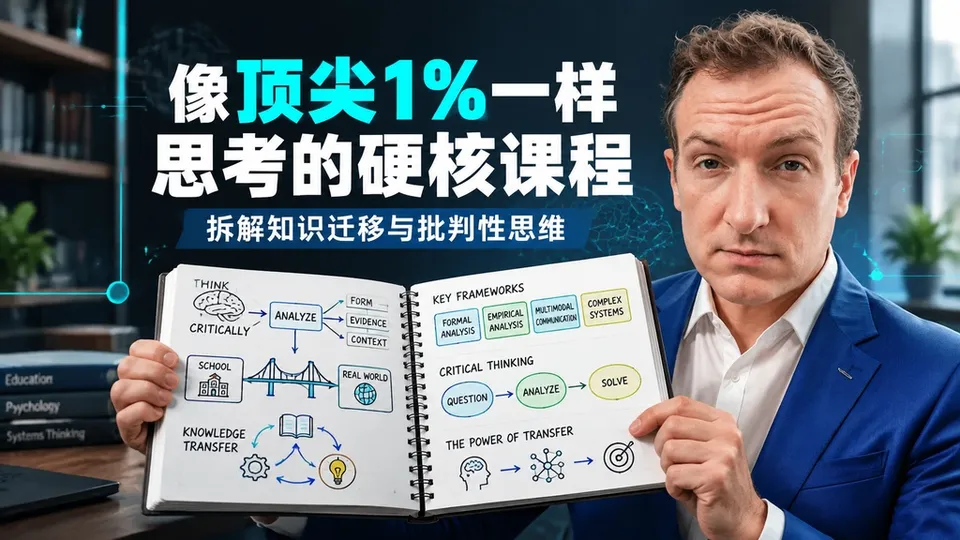
formal analyses, empirical analyses, multimodal communications, and complex systems. But don't let those academic labels obscure just how practical this can be. Imagine, for instance, that you are deciding whether to leave your current job for a new offer.
形式分析、实证分析、多模态沟通,以及复杂系统。但不要让那些学术标签掩盖了这有多么实用。例如,想象一下,你正在决定是否要离开当前的工作,接受一份新工作。
Formal analysis asks, "What conclusion am I reaching and which assumptions would have to be true for that conclusion to follow?" Empirical analysis asks, "What actual evidence do I have about the company?
形式分析问,“我得出的结论是什么,以及哪些假设必须成立才能使该结论成立?”实证分析问,“关于这家公司,我有哪些实际证据?
and am I generalizing from a few unusually positive or negative experiences? Multimodal communication asks which conversations do I need to have and how should my message change when speaking to my current employer, my spouse or the new company?
我是否仅根据少数异常正面或负面的经历就以偏概全?多模态沟通要求我需要与谁进行哪些对话以及我的信息应如何变化在与当前雇主交谈时,与我的配偶或新公司交谈时?
And complex systems analysis asks, how could this decision alter my finances, relationships, future opportunities, and behavior over time? You see, the point here is that the otherwise generic prescription to make a good decision has now been decomposed into explicit operations that can be practiced and whose improvement can be measured.
复杂系统分析则要求,这个决定会如何改变我的财务状况、人际关系、未来机会,以及长期的行为?你看,这里的重点是原本泛泛而谈的方法即如何做出好的决策,现在已被分解为明确的操作步骤这些步骤可以练习,其进步也可以衡量。
And so, here's an exercise you can practice based on this principle. Choose one decision or problem that genuinely matters to you and divide a page into four boxes corresponding to the four cornerstones.
因此,这里有一个你可以练习的练习基于这一原则。选择一个决定或问题它对你真正重要并将一页纸分成四个方框分别对应四个基石。
In the formal box, list the assumptions and logic underneath your current conclusion. In the empirical box, list the evidence you possess and the evidence you still need. In the communication box, identify the relevant audiences and how their perspectives differ.
在形式方框中,列出假设和逻辑在你当前结论的下方。在经验方框中,列出你拥有的证据以及你仍然需要的证据。在沟通框中,确定相关的受众以及他们的观点有何不同。
And in the systems box, map the second and third order consequences that could unfold. And from here, congratulations. You have now taken something that otherwise would have stayed vague and converted it into an actual executable system of practice.
在系统框中,绘制二阶和三阶后果可能展开的情况。从这里开始,恭喜。你现在拿走了一些本来会一直模糊不清的东西并将其转换为一个实际可执行的实践体系。
But knowing the thinking tool does not mean you can actually use it. And that brings us to principle number two. Turn every lesson into a performance. You see, Manurva operates through what it describes as an extreme flipped classroom.
但了解这个思维工具并不意味着你实际上可以使用它。这就引出了我们的第二条原则。把每一堂课都变成一场表演。你看,马努尔瓦通过它所描述的一种极致的翻转课堂来运作。
Students obtain the initial information before class through readings and structured preparation. The live class is then devoted to active use. Analyzing a problem, defending a conclusion, responding to a counterargument, interpreting the evidence, or revising an answer when new information appears.
学生在课前通过阅读和结构化的准备来获取初步信息。然后,直播课程则专注于主动运用。分析问题,为结论辩护,回应反驳,解读证据,或在新信息出现时修改答案。
And this is much harder than it sounds. You see, when you're listening to an articulate professor explain an idea, you can actually fall prey in that moment to feeling like you totally understand it.
而这远比听起来要难得多。你看,当你在听一位口齿清晰的教授解释一个概念时,你实际上会在那一刻陷入一种觉得自己完全理解了的错觉。
After all, every sentence you hear might actually feel like it makes sense as it enters your mind. You recognize the terminology, follow the examples, and perhaps even predict the next point.
毕竟,你听到的每一句话在进入你脑海时可能都会让你觉得它是有道理的。你认得那些术语,跟得上那些例子,甚至可能预测出下一个要点。
But this perception in the moment is often not learning at all. In fact, it's often what psychologists term the illusion of competence. And so, Manurva's virtual classroom platform was designed to address this very problem.
但此时此刻的这种认知往往根本不是学习。事实上,这往往是心理学家所称的能力错觉。因此,Manurva的虚拟课堂平台正是为了解决这一问题而设计的。
Instructors can see who's participating, use polls and smaller group activities, and deliberately call upon students rather than allowing the same confident minority to dominate every discussion.
教师可以看到谁在参与,使用投票和小组活动,并有意点名提问学生,而不是让少数自信的学生主导每一次讨论。
Classes can also be recorded so that particular applications of thinking skills can be evaluated and followed by feedback. In other words, within the Manurva system, there's very little room to just disappear into the back of the lecture hall.
课程还可以被录制下来,以便对思维技能的特定应用进行评估,并随后给予反馈。换句话说,在马努尔瓦体系中,几乎没有空间可以悄悄消失在讲堂后排。
And this general principle has substantial research behind it. In the 2014 metaanalysis, active learning increases student performance in science, engineering, and mathematics, Scott Freeman and his colleagues analyzed 225 studies.
而这一普遍原则背后有大量研究支持。在2014年的元分析中,主动学习能提高学生在科学、工程和数学方面的表现,斯科特·弗里曼及其同事分析了225项研究。
Students in active learning classes performed better on examinations, while students taught through traditional lectures were approximately 1 and a half times as likely to fail. Now, this doesn't mean that lectures have no value.
参与主动学习课堂的学生考试成绩更好,而接受传统讲授式教学的学生不及格的可能性大约要高出1.5倍。当然,这并不意味着讲授毫无价值。
I've conducted many myself with great results. But the problem arises when students confuse their exposure to the explanation as understanding or even as mastery of the subject. And so after studying anything important, perform what I call a closed book defense.
我自己也进行过许多次讲授,效果很好。但问题在于,学生会把他们接触到的讲解误认为理解甚至误认为已经掌握了这门学科。因此,在学完任何重要的内容之后,都要进行我所说的闭卷答辩。
Close the source and do four things. Explain the idea without reproducing the author's exact vocabulary. In other words, as I constantly tell my own students, say it in your own words.
合上资料来源,做四件事。解释这个观点而不必照搬作者的原有措辞。换句话说,正如我常常对自己学生说的,用你自己的话把它说出来。
What's more, push yourself to do the following. One, produce an example the author never even used. Two, apply the idea to a real problem. And three, formulate the strongest objection you can against your own application.
此外,还要督促自己做到以下几点。第一,举一个作者甚至从未用过的例子。第二,把这个理念应用到一个真实问题上。第三,针对你自己的应用,构思出最强烈的反驳来反对你自己的应用。
Because you see, if you can't do those four things, you may have recited or memorized the information, but you've not actually made it usable. And by the way, if you want a deeper dive into these and other critical thinking methods, then be sure to check out my free master class at the link in the pinned comment below.
因为你看,如果你做不到这四件事,你可能背诵或记住了这些信息,但你并没有真正让它变得可用。顺便说一下,如果你想更深入地了解这些以及其他批判性思维方法,那么一定要看看我的免费大师课,链接在下方置顶评论中。
Which brings us to principle number three. Change the surface while preserving the structure. This is the heart of Manurva's curriculum because it addresses one of the deepest problems in education.
这就引出了第三条原则。改变表面,同时保留结构。这是Manurva课程的核心,因为它解决了教育中最深层的问题之一。
Transfer. Transfer occurs when something learned in one context changes how you reason in a different context. And you might have noticed that I've harped on this issue again and again in several videos because yes, it is that important.
迁移。迁移发生在某一情境中学到的东西改变了你在不同情境中的推理方式时。你可能已经注意到,我在好几个视频中反复强调这个问题因为没错,它就是这么重要。
Throughout my own teaching, I've encountered highly intelligent people who can solve a formal logic puzzle almost immediately. For instance, but who accept invalid reasoning when they are emotionally invested in an everyday disagreement.
在我自己的教学过程中,我遇到过非常聪明的人他们几乎能立刻解出形式逻辑谜题。例如,但会接受无效推理的人当他们情感投入时在日常分歧中。
I've also encountered students who know perfectly well that correlation does not prove causation, but seem to forget this the moment the claim appears inside a news story, a workplace report, or something else they're emotionally invested in.
我也遇到过一些学生,他们完全清楚相关性并不能证明因果关系,但似乎会忘记这一点当这一说法出现在新闻报道中时,一份工作场所报告,或他们情感投入的其他事物中。
And so, what's going on here? Well, you see, in school, you're presented with a specific question in a specific form, requiring a specific tool and having often only one right answer.
那么,这里到底发生了什么?嗯,你看,在学校里,你会遇到一个以特定形式呈现的特定问题,需要特定的工具而且往往只有一个正确答案。
For instance, if a question they need to answer appears under the heading correlation and causation, well, the student knows what mistake to look for. In life, however, the same problem is presented to you disguised as sales increased after our rebrand, "My health improved after taking the supplement or my friend became distant after that conversation."
例如,如果他们需要回答的问题出现在相关性与因果关系的标题下,那么,学生就知道该寻找什么错误。然而在生活中,同样的问题会呈现在你面前,伪装成“我们品牌重塑后销售额增长了,”“我服用补充剂后健康状况改善了,或者“那次谈话后我的朋友变得疏远了。”
And you have to independently be able to spot the structure of the problem or statement, know which thinking tool to use and apply it effectively. And this is precisely why Manurva gives its thinking tools specific names and then requires students to apply them across different courses and increasingly specialized problems.
你必须独立地能够识别出问题或陈述的结构,知道该使用哪种思维工具并有效地应用它。而这正是马努尔瓦为其思维工具赋予特定名称,然后要求学生将它们应用于不同的课程以及日益专业化的问题中的原因。
In other words, the service content and context changes, but the student is supposed to recognize the same structure underneath it. And classic research in what is called analogical reasoning helps explain why this is necessary.
换句话说,服务内容和情境会发生变化,但学生应当识别出其底层相同的结构。而所谓的类比推理方面的经典研究有助于解释为什么这是必要的。
In their classic 1983 study, schema induction and analogical transfer, psychologists Mary Gick and Keith Holio gave participants stories that shared a deeper solution pattern with a later problem.
在他们1983年的经典研究中,图式归纳与类比迁移,心理学家玛丽·吉克和基思·霍利奥给参与者提供了一些故事,这些故事与后续问题共享一个更深层的解决方案模式。
Merely encountering a relevant example often didn't produce spontaneous transfer. However, comparing analogous cases and identifying their shared structure made transfer more likely.
仅仅接触一个相关的例子往往不会产生自发的迁移。然而,比较类比案例并识别其共享结构使迁移更有可能发生。
And so the lesson here is that experience alone does not necessarily teach the general principle hidden inside the experience. Instead, you must deliberately and explicitly extract that structure and practice recognizing it in a wide variety of contexts.
所以这里的教训是,单凭经验并不一定能教会在经验中隐藏的普遍原则。相反,你必须刻意且明确地提取那个结构并练习在各种各样的情境中识别它。
And in fact, it's this very point that brings us to principle number four. Grade the reasoning, not merely the answer. You see, a correct answer can be produced by terrible reasoning.
而事实上,正是这一点将我们引向第四条原则。评估推理过程,而不仅仅是答案。你看,一个正确的答案可能来自糟糕的推理。
Conversely, you can use an intelligent method, overlook one crucial piece of evidence and reach the wrong conclusion. And so, if we evaluate only the final answer, we lose the information needed to improve the underlying process.
反过来,你可能使用一种聪明的方法,却忽略了一条关键证据,从而得出错误的结论。因此,如果我们只评估最终答案,我们就会丢失所需的信息,来改进底层过程。
And this is why Manurva therefore attaches a fivepoint mastery rubric to each habit of mind or foundational concept. A student can receive feedback on how well a particular tool was applied during an assignment, project, or a contribution in class.
这就是为什么Manurva因此附上一个五点掌握量规到每个思维习惯或基础概念上。学生可以获得反馈关于某个特定工具应用得如何在作业期间,项目或课堂贡献中。
More radically, assessment of these HC's continues after the first year. Cornerstone courses in the model Manurva has described later demonstrations of mastery can update the evidence used to evaluate the students foundational learning.
更激进的是,对这些HC的评估会持续到第一年之后。马努尔瓦所描述的模型中的基石课程之后的展示掌握程度可以更新证据用于评估学生的基础学习。
Interestingly, these have been described as timetraveling grades. In other words, the idea here is that your performance years later reveals whether the skill introduced in your first year actually improved and became transferable.
有趣的是,这些被描述为穿越时空的成绩。换句话说,这里的观点是,你多年后的表现揭示了第一年引入的技能是否真正得到了提升并变得可迁移。
And actually, I think this might just be the most brutal part of the system. In most traditional curricula, you can cram, perform well once, receive the grade, and then just allow the knowledge to disappear.
而且实际上,我认为这可能正是这个体系中最残酷的部分。在大多数传统课程中,你可以死记硬背,在一次考试中表现出色,拿到成绩,然后就让知识消失殆尽。
But imagine being told that the real examination will occur 2 years later inside another discipline without anyone announcing which firstear concept you're expected to remember. Well, in effect, this actually makes it much harder for you to just learn something, get a grade in it, and then forget all about it because, well, you already got the grade, didn't you?
但想象一下,有人告诉你真正的考试将在2年后在另一门学科中进行,却没有人告诉你你需要记住哪个一年级的哪个概念。实际上,这反而让你更难只是学点东西,拿到一个分数,然后就把它忘得一干二净,因为你已经拿到分数了,不是吗?
Which is unfortunately how a lot of students operate. Which brings us to principle number five. Recycle the tool until it becomes instinctive. You see, a traditional curriculum is largely organized around completion.
不幸的是,很多学生就是这样做的。这就引出了我们的第五条原则。反复运用这个工具,直到它成为本能。你看,传统的课程很大程度上是围绕完成来组织的。
You finish algebra, move to geometry, complete the course, and receive credit. But as we just discussed, once you complete a course and get a grade, do you actually remember what you learned 5 years later?
你学完代数,进入几何,完成课程,然后获得学分。但正如我们刚才讨论的,一旦你完成一门课程并拿到成绩,五年后你真的还记得学过的东西吗?
How about 10 years later? Yeah, I thought so. And the reason for this is that a skill that is not retrieved, varied, and used will become less accessible regardless of what your transcript says you mastered at a certain point in time.
那十年后呢?是啊,我就知道。这样做的原因是,一项未被检索、变化和使用的技能会变得难以获取,无论你的成绩单上说你掌握了什么在某个时间点。
And so Manurva's curriculum therefore spirals. The HC's are introduced during the first year cornerstones, applied inside a student's major, deepened inside more specialized concentration courses used in real world projects, and ultimately brought together through advanced work.
因此,Manurva的课程呈螺旋式上升。HC在一年级的基石课程中引入,在学生的专业中应用,在更专业的集中课程中深化,在现实世界的项目中使用,并最终通过高级工作整合在一起。
And the capstone, the aim is not simply that students remember the definition of a thinking tool. It's that the appropriate tool begins activating when the structure of a new problem demands it.
而顶点,目的并不是简单地让学生记住思维工具的定义。而是当新问题的结构需要时,适当的工具开始被激活。
And so to round all this out, here is how I would build a 12-week version of this curriculum. In week one, choose one genuine problem with stakes attached to it. A business decision, a research question, a professional transition you're trying to make, a community problem, or an intellectual project.
因此,为了完善这一切,以下是我如何构建这个课程的12周版本。在第一周,选择一个真正的问题,并让它与利害关系相连。一个商业决策,一个研究问题,你正试图完成的职业转型,一个社区问题,或一个知识项目。
Then select four tools or mental models, one corresponding broadly to each cornerstone. You might choose identifying assumptions for formal analyses, evaluating causal evidence for empirical analyses, adapting a message to an audience for multimodal communications, and mapping feedback loops for complex systems.
然后选择四种工具或思维模型,分别大致对应每一个基石。你可以选择识别性假设用于形式分析,评估实证分析的因果证据,使信息适应受众用于多模态传播,并为复杂系统绘制反馈回路。
During weeks 2 through 9, devote two weeks to each tool. Before each session, read enough to understand the tool and examine at least two worked examples. Then, close the material and perform your closed book defense.
在第2周到第9周期间,为每个工具投入两周时间。在每次课程之前,阅读足够的内容以理解该工具并至少研究两个已解决的示例。然后,合上材料并进行闭卷答辩。
Apply the tool to your central problem. Transfer it to two unrelated situations and grade the application with your rubric. At the end of each twoe block, ask another person to challenge your reasoning.
将该工具应用于你的核心问题。将其迁移到两个不相关的场景中并用你的评分标准对应用情况进行评分。在每个两小时区块结束时,请另一个人质疑你的推理。
If nobody can examine the work directly, then write the strongest adversarial critique yourself. During weeks 10 and 11, stop practicing the tools separately. Analyze two new problems using all four without labeling in advance which tool belongs where.
如果没有人能直接检查这项工作,那就自己写出最有力的对抗性批判。在第10周和第11周期间,停止单独练习这些工具。用这四种工具来分析两个新问题而不事先标明哪种工具适用于哪里。
And this is key because real life will not present you with four neat boxes. Instead, you're going to have to diagnose the problem before selecting the method. Finally, in week 12, produce a capstone, an essay.
这一点很关键因为现实生活不会为你呈现出四个整齐的方框。相反,你必须先诊断问题再选择方法。最后,在第12周,完成一个顶点项目,一篇论文。
It could be a presentation. It could be a business proposal, a research analysis, a decision memorandum in which all four tools visibly improve the final product. Then preserve that work and reassess it one month later using the same rubric.
可以是一次演示。可以是一份商业提案,一份研究分析,一份决策备忘录,其中所有四种工具都能明显改进最终成果。然后保留那份成果并在一个月后用同样的标准重新评估。
If your skills remain available and easily able to be called upon after the original learning context has disappeared, you're beginning to achieve genuine transfer. And it's this kind of transfer that ultimately leads to mastery.
如果你的技能仍然可用并且很容易被调用在最初的学习情境消失之后,你开始实现真正的迁移。正是这种迁移最终会通向精通。
If you want to keep leveling up your critical thinking to make a massive impact not only on your own life, but also on the lives of countless others, then be sure to watch this next
如果你想继续提升你的批判性思维不仅对你自己的生活产生巨大影响,还能影响无数其他人的生命,那么一定要观看接下来的这个